Littjara Mirrorlake
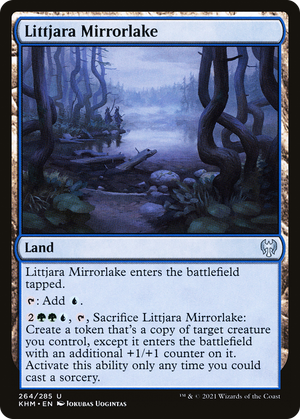
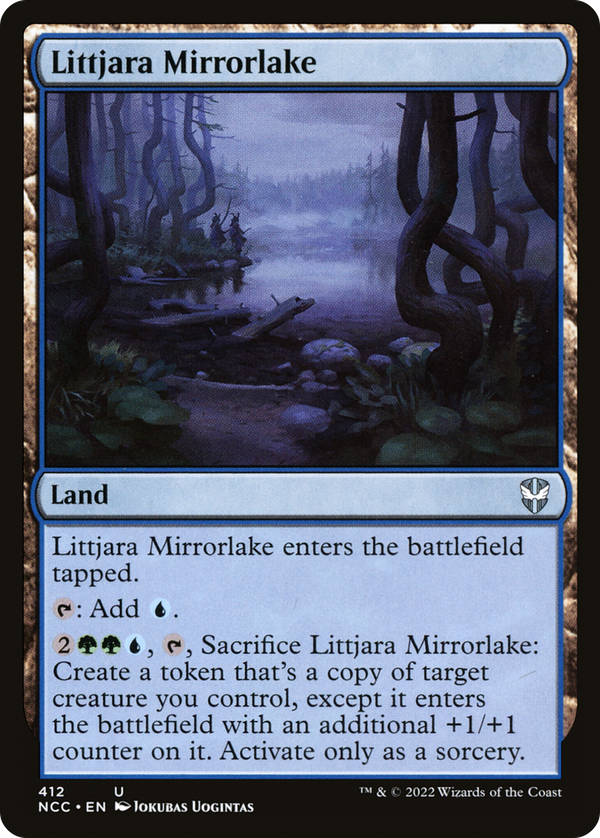
Most of the game it just makes blue mana entering tapped, a deliberately dull rate that keeps it from clogging your early draws while it waits. The payoff is what the card is actually for: five mana across two colors plus the land itself buys a copy of one of your creatures, and the token arrives one size larger than the original. Sacrificing the land is the price, which means the ability wants a board already worth duplicating (a creature with an enters-the-battlefield trigger, a token engine that snowballs, a body big enough that a second one closes the game) and a game that has stalled long enough for you to spend a land as a spell. The sorcery-speed clause is where the pricing gets honest: this cannot ambush a combat step or fire on the opponent's turn, so every copy is a proactive main-phase board-building play, never a trick. The design logic is that a land slot is the cheapest place to hide a copy effect. It asks nothing of your spell count until the turn you finally have mana to burn, so you are running a mana source that quietly converts into a threat the moment the game goes long. What you surrender is a land at exactly that point, which is why the ability rewards decks that have already built a battlefield worth photographing rather than fishing for a single big creature to loop.
Rules text
 : Add
: Add  .
.

 , , Sacrifice this land: Create a token that's a copy of target creature you control, except it enters with an additional +1/+1 counter on it. Activate only as a sorcery.