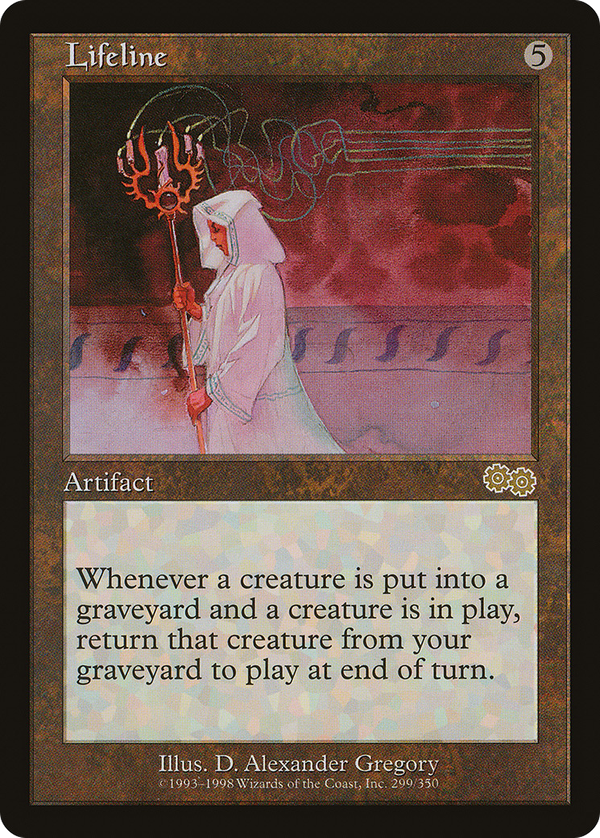
Lifeline

Nothing stays dead here, so long as one creature is left to keep the field running. The recursion fires for both players and ignores how a creature died, which turns this into a puzzle of attrition rather than an engine you simply ride. The play pattern is governed by a single threshold: "another creature is on the battlefield" versus "no creature is." You grind the board down to one body, then remove that last one so the field collapses and only your side rebuilds, or you weaponize the loop with sacrifice triggers that fire over and over while the bodies keep coming back. The delayed return at the next end step is the timing seam doing the real work, separating the death from the recursion so combat, removal, and stack interactions all get a window before everything resets. Resilience goes to whoever sequences better, not to whoever cast the artifact, which is why building around it has always meant treating the off-switch as carefully as the engine: a board wipe that exiles, an edict at the right moment, a single creature held back. The reward goes to whoever understands exactly when the clause stops applying. An early-era artifact, it predates the aristocrat decks that would have loved it most, a symmetrical resurrection field handed to a metagame that did not yet know what to do with it.