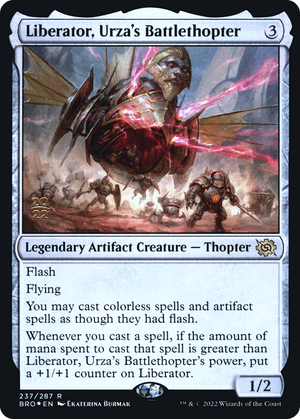
Liberator, Urza's Battlethopter

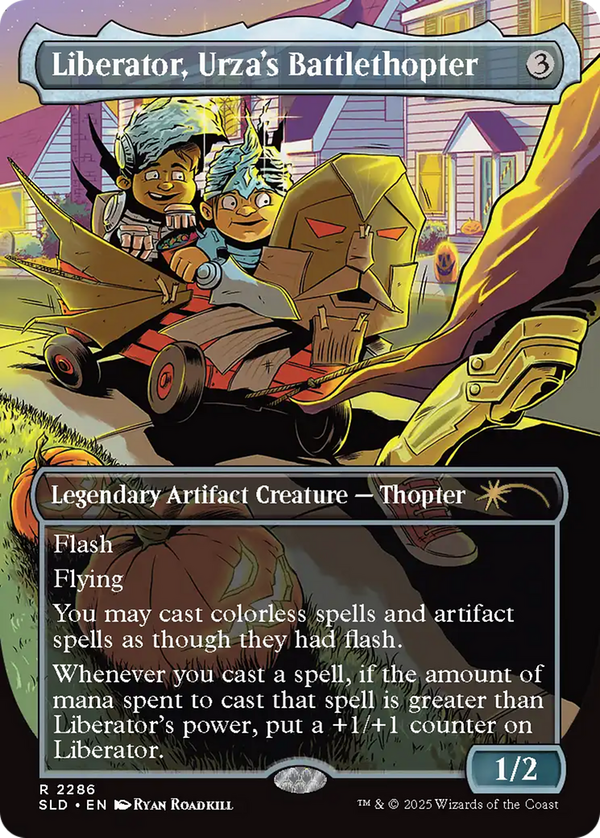
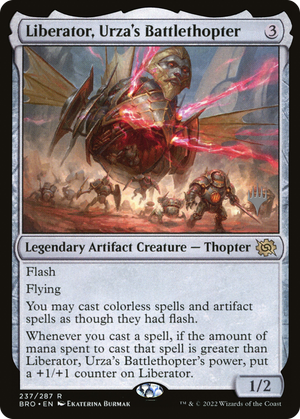
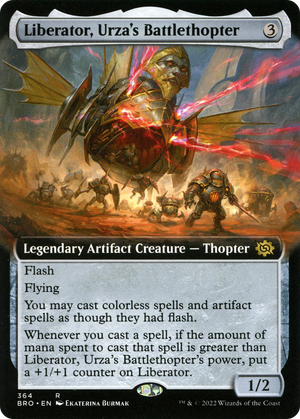
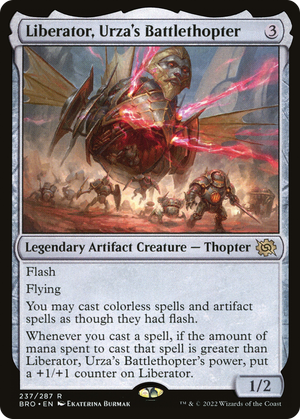
The permission it grants is quietly one of the most disruptive things a static ability can do to an artifact-heavy deck: every colorless spell and artifact spell in your hand gains flash, which turns a durdly value pile into an ambush engine. But the counter clause is where the design gets sharp. It grows only when you spend more mana on a spell than its current power, so it starts as a 1/2 that any two-mana cast will pump, then a 2/3 that a three-mana spell answers, and so on. The body scales precisely with the cost of what you deploy, meaning the card is largest exactly when you are casting your most expensive artifacts. That self-limiting slope is the tension: it rewards ramping into big colorless spells while never letting the counter accrue for free, and it caps naturally once your curve tops out below the current power. Flash on its own body matters too, because it can arrive at the end of an opponent's turn and then hold up its whole hand of now-flash artifacts as instant-speed threats. The result is a three-mana legend that reads like a Simic-style tempo enabler dressed in mono-artifact clothes, using a growth trigger tied to genuine investment rather than to raw spell count. It is a value permission stapled to a scaling clock, and the two halves reinforce each other rather than competing for the same slot.