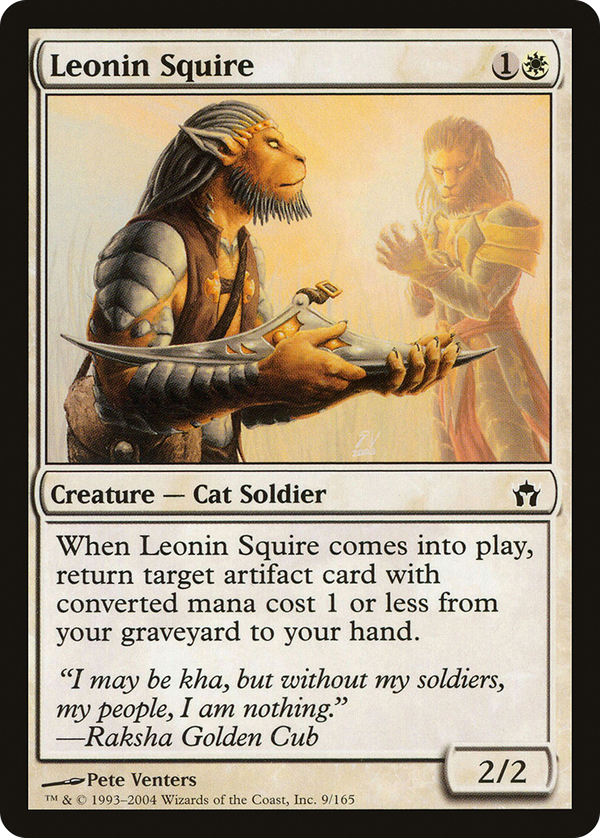
Leonin Squire


The recursion clause is deliberately stuck at the bottom of the artifact curve: it fetches only the cheapest pieces, the trinkets and zero-cost equipment and tiny artifact bodies that an artifact deck runs by the dozen. That ceiling is doing the load-bearing work. A squire that could buy back any artifact would be an open-ended toolbox; capped at the floor, it can only return fodder, never the payoff. In a deck stitched together from one-cost artifacts, the limitation becomes the point: drop the squire, return a cheap part, replay it, and with a sacrifice outlet the loop tightens into a slow engine of recurrence rather than a burst of card advantage. The body is incidental, a placeholder so the card does something the turn it lands, but the trigger is the reason it exists. What it asks of a builder is unusual: stock the graveyard with disposable one-drops and treat the cheap pieces as the synergy itself, not as ramp toward bigger ones. It comes from an era when white was being handed small artifact-matters hooks, modest enablers meant to slot a controlling or value-grinding color into the artifact archetypes that defined the period's central axis. Its strategic identity is repetition of the cheap parts, a soft loop measured in tempo and density rather than raw cards drawn.