Leave // Chance




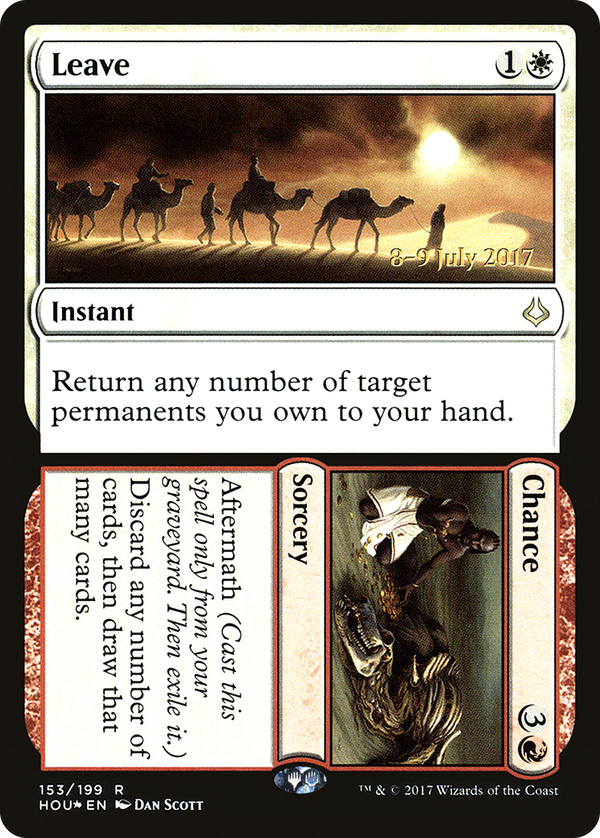
Aftermath splits a card's versatility across time rather than across a menu: instead of one spell offering a choice you resolve at cast, you get a front half from your hand now and a wholly separate back half from your graveyard later. This pairing shows why the structure works. Leave is bounce that only touches permanents you own, which reads as a restriction until you frame it as a self-reset: scoop a board's worth of creatures in response to a sweeper, reload your own enters-the-battlefield triggers, or lift your permanents out of a global effect on your own terms. What it cannot do is answer an opponent's problem, since the target clause is limited to what you own; its whole job is undoing your own bad situation, not attacking theirs. It costs tempo but buys a reversal, which is a different currency entirely. Chance is graveyard rummaging in card-draw clothing, pitching a fistful before it replaces them and then exiling itself, and it wants to be cast late, after the game has stabilized and you need fuel rather than defense. The distance between those two moments is the design. Bounce is a spell for when you are behind; the rummage is a spell for when you are ahead and digging. One card holds a hand slot for the front half and waits in the yard for the back, never asking you to pay for or commit to both at once. The cards you discard to Chance are exactly the ones a graveyard deck wants in the bin, folding the effect back into the same recursion logic aftermath is built on.