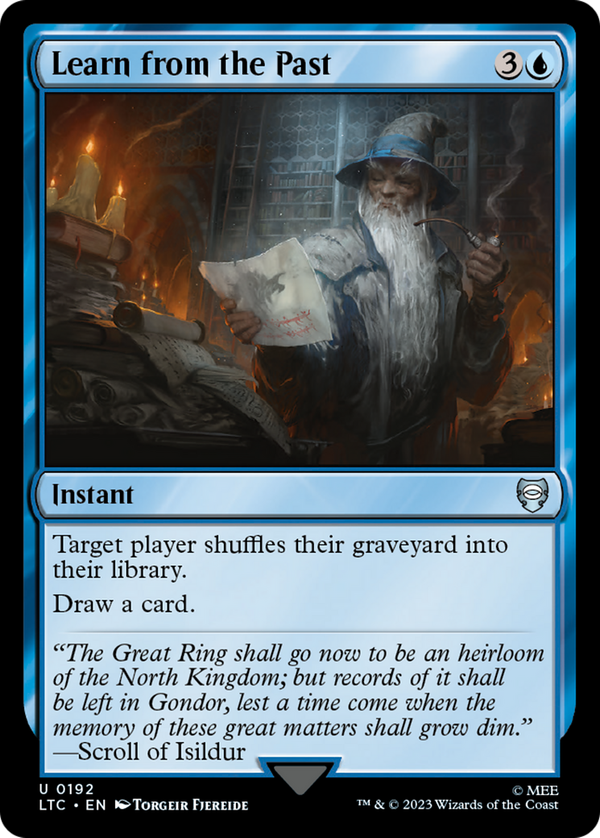
Learn from the Past


Graveyard hate that refuels instead of just denies. The dominant model for interacting with a graveyard has always been one-directional: exile the yard, strip the resource, eat the card disadvantage as the price of the disruption. This runs sideways to that. Shuffling a graveyard into its owner's library is a softer form of interference, a delay rather than an exile, one the target can eventually draw back into, and the replacement card means you don't fall behind for casting it. Instant timing carries most of the design's weight: held up against a reanimation spell or a flashback engine, it can scatter the fuel in response, at the exact moment the cost is highest. The choice of target player is the quiet flexibility most people overlook, since aiming it at yourself turns the effect into a deck refill in grindy games, folding spent removal and threats back into your library where they can be drawn again, while also blanking an opponent's plan to mill or exile you by emptying the yard they were counting on. That dual use, disruption pointed outward or recursion pointed inward, gives it a reach the one-note exile pieces can't match. The catch is the rate: four mana to touch a graveyard is slow next to the one- and two-mana exile effects, so it earns its keep as a maindeck card justified by replacement and flexibility, not as a cheap reactive answer.