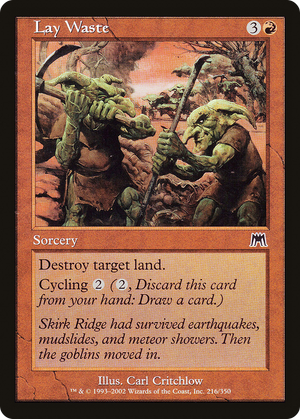
Lay Waste


Land destruction has always carried a tax that creature removal does not: if the opponent has no land worth killing, the spell sits dead in your hand. Cycling is the elegant answer to that problem, and this card is its plainest demonstration. Stripping a land matters enormously in the opening turns and against greedy fixing, but loses value as the game opens up and lands become surplus. The hedge does not arrive at the moment you cast: it comes from the hand, before you commit any mana to the cast. When the land kill is live, you cast it. When it would be a dead card, you pay two and discard it to draw something useful instead. That asymmetry is what makes cycling such a durable design lever: it smooths the variance of narrow effects without making them universally good, because the cantrip mode is always strictly worse than landing the effect would have been. This early-era design attached cycling to a long bench of situational commons and uncommons on exactly this logic, so that the spell you draw is never a blank. A single-target land kill that refuses to ever be a dead draw became the template Wizards has reused every time it wants to print a narrow answer players will still happily run.
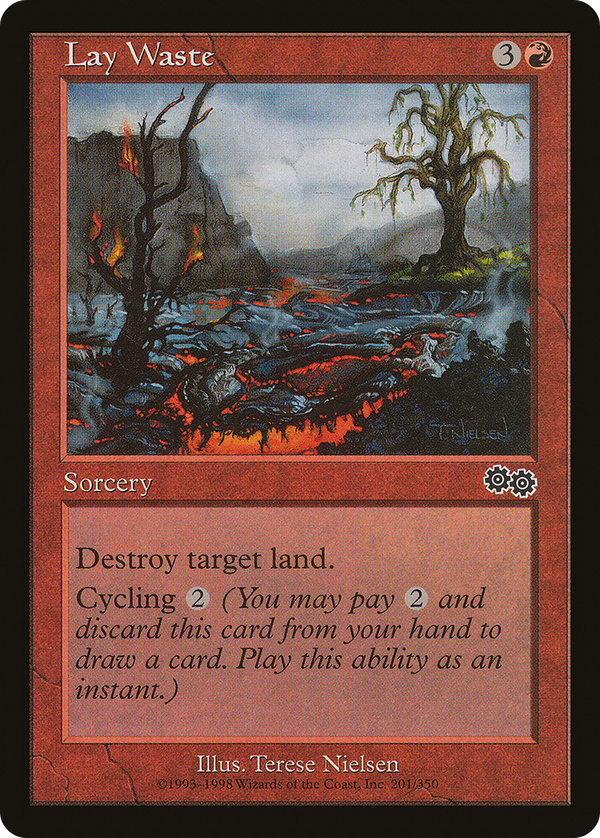
Rules text
 (, Discard this card: Draw a card.)