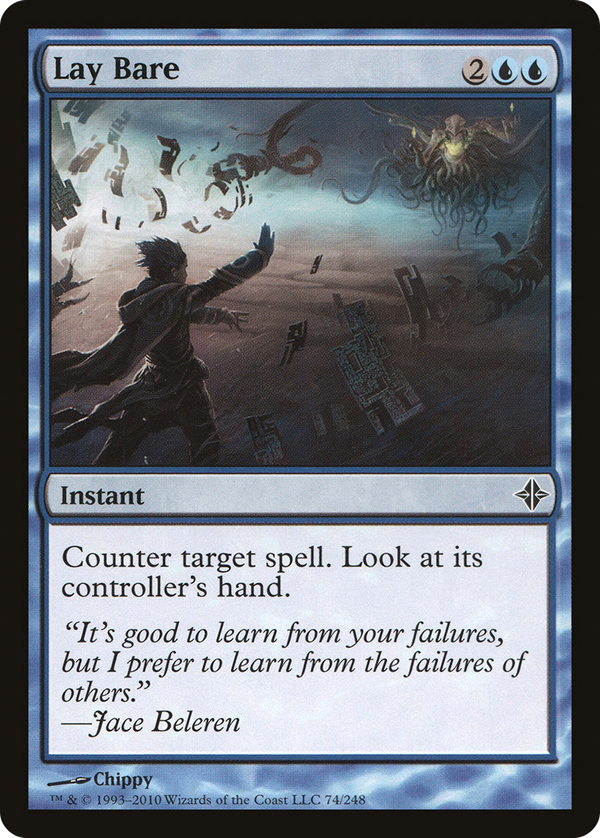
Lay Bare


The information rider is the whole pitch, and it tells you exactly how this kind of counterspell expects to earn its keep. A four-mana hard counter with no other text would be unplayable in any era that had Counterspell on the books; the look-at-hand clause is what justifies the markup. The trade isn't just spell-for-spell, it's spell-for-spell-plus-a-scouting-report, and in a slower deck the scouting report is sometimes worth more than the counter. Knowing whether the opponent is holding a second threat or running on empty changes how you sequence the next three turns: whether you tap out, whether you hold up the next answer, whether you can safely commit your own threat. The card sits in a small family of counterspells that pay a premium for card knowledge, where the counter is the floor and the read is the ceiling. The catch is the price. Four mana at instant speed is a real concession in any tempo-sensitive context, and the hand-peek does nothing to bend the curve back in your favor; you are paying double Counterspell's rate for a value that only materializes if the game goes long enough for the information to matter. That tension (cheap interaction wants to be cheap, but knowledge wants to be bought) is the line every variant of this design walks.