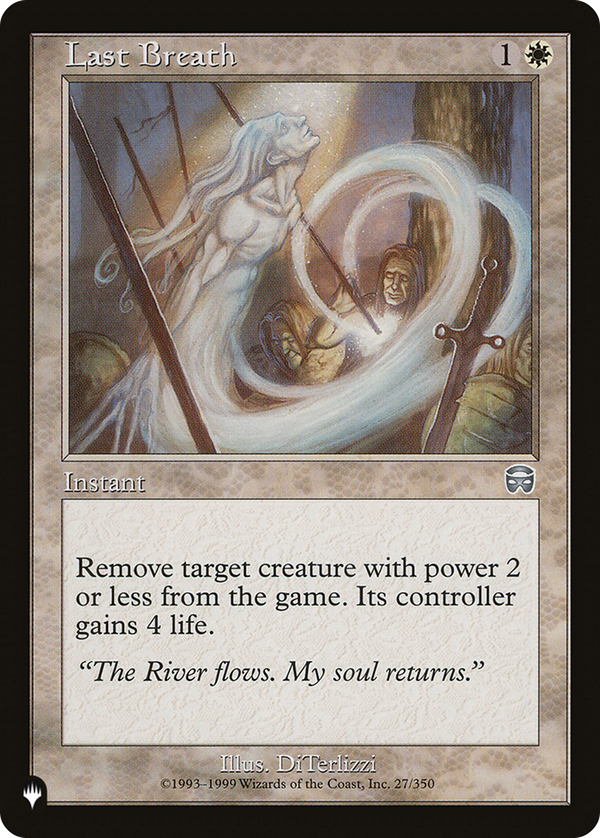
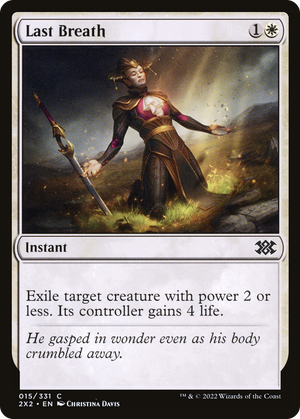
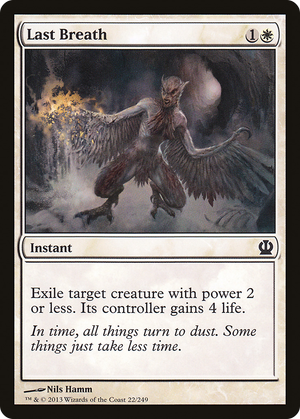
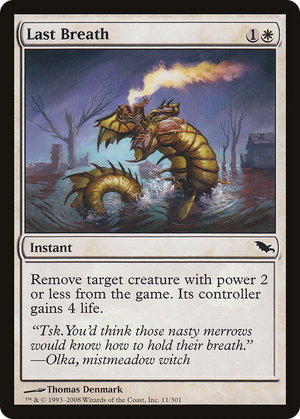
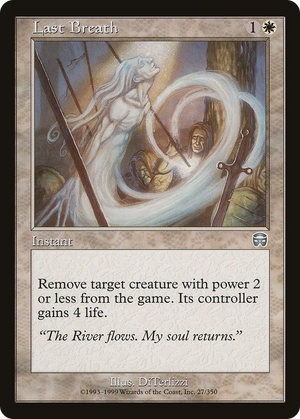
Last Breath


The exile clause is what keeps this honest. Power-capped removal is cheap by nature, and white has always had ways to neutralize small creatures; what sets this apart is refusing to leave a graveyard or a recursion target behind. Against a one-drop with a death trigger, a creature wearing counters someone hopes to recoup, or anything that wants to crawl back from the yard, exile sidesteps the whole conversation. The four life is the design tax that pays for that clean answer: the controller of the exiled creature gets it, not you, so the spell that removes a threat also pushes your own clock back a turn or two. That tradeoff is the entire identity. It is removal you point at an aggressive deck's cheap pieces precisely when you most want to slow them down, and it is removal you hesitate over when the four life undoes damage you had already invested. The power-2-or-less ceiling draws a hard line: this is an answer to the bottom of the curve, never a catch-all, and the more expensive a creature gets the less this card has to say. White instant-speed removal has carried many faces since, most trading the lifegift for a flat exile or a stat restriction of their own, but the shape here (exile the small thing, hand back life) is one of the cleaner expressions of "you may have the body removed, but not for free."