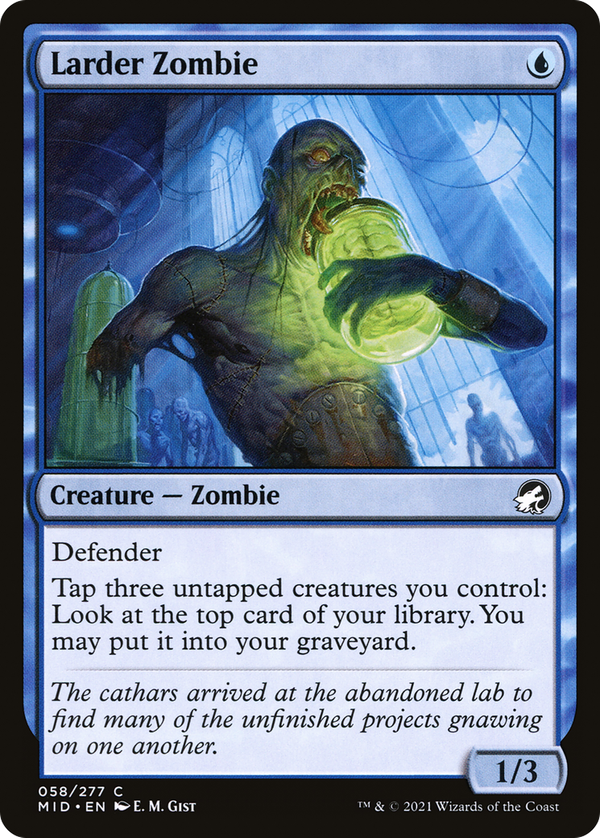
Larder Zombie

The activation cost is the whole design problem, and it's a strange one: tapping three creatures to filter a single card is a rate that only pays off when a board is already wide, defensive, and in no hurry. A 1/3 with Defender holds the ground for a graveyard strategy while the surveil quietly stocks the yard, but the tap-three clause means the ability competes with everything else those bodies could be doing. The creatures have to be untapped when you activate, so the surveil is genuinely rationed by your board's other obligations: bodies you've already fed to a sacrifice engine, or ones you attacked with this turn, aren't available. The ability itself carries no timing restriction, so a defensive board can hold up its blockers and then tap them for surveil after combat or on the opponent's end step, once their blocking work is done. The surveil does double duty: card selection when you want lands or gas, graveyard-filling when you want fuel, and the payout depends entirely on which of those jobs the surrounding shell is built to reward. This is a value creature that earns out over a long game and does almost nothing in a short one, exactly the trade a self-mill or aristocrats build is built to make. A one-drop wall that turns a stalled position into slow, repeatable graveyard advantage: modest on its own, coherent as a cog in a machine that has decided the graveyard is where its value lives.