Lantern of Revealing

The lineage here is the mana rock that also digs, and the four-mana activation is where the real design lives. Any-color fixing on a three-mana artifact is unremarkable; plenty of rocks do exactly that. What separates this one is the second ability, which reads the top card of your library and reacts to it: if it's a land, drop it straight onto the battlefield tapped; if you decline (or the card isn't a land), bury it on the bottom to reset your next draw. That's a steep price, four mana plus the tap, seven total across two turns to accelerate one land or effectively scry-to-bottom whatever you don't want. The card is deliberately backloaded. Early, it's fixing. Late, when spare mana piles up and every extra land is another turn of acceleration, the activation becomes a slow, repeatable land engine that also filters flooded or dead cards away. The comparison point is Explorer's Scope and the broader family of top-of-library manipulation, but where the Scope hangs its top-deck reading off a creature via Equipment and only fires on attack, this rolls fixing and filtering into a single self-contained artifact you activate on your own schedule. It rewards decks with high land counts and expensive payoffs, where cheating a land into play a turn early and burying dead draws both matter more than the mana they cost.
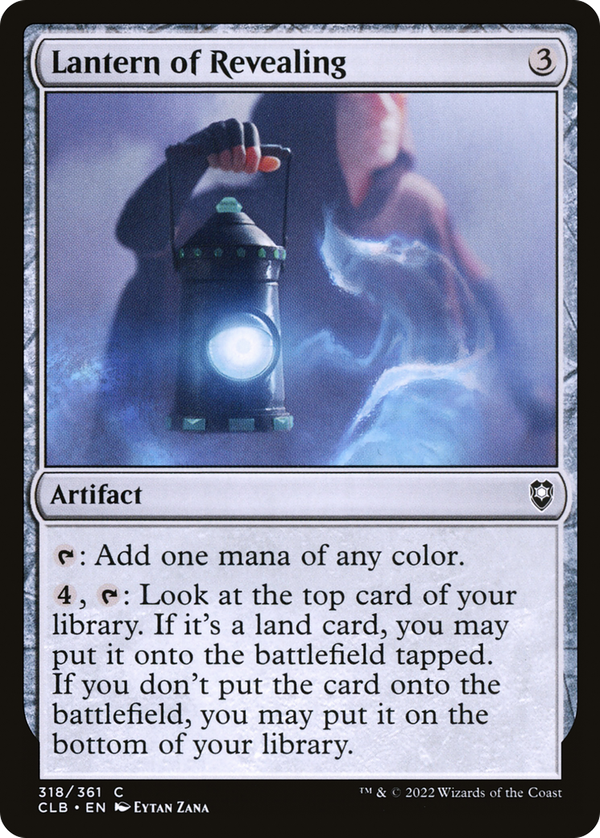
Rules text
 : Add one mana of any color.
 , : Look at the top card of your library. If it's a land card, you may put it onto the battlefield tapped. If you don't put the card onto the battlefield, you may put it on the bottom of your library.