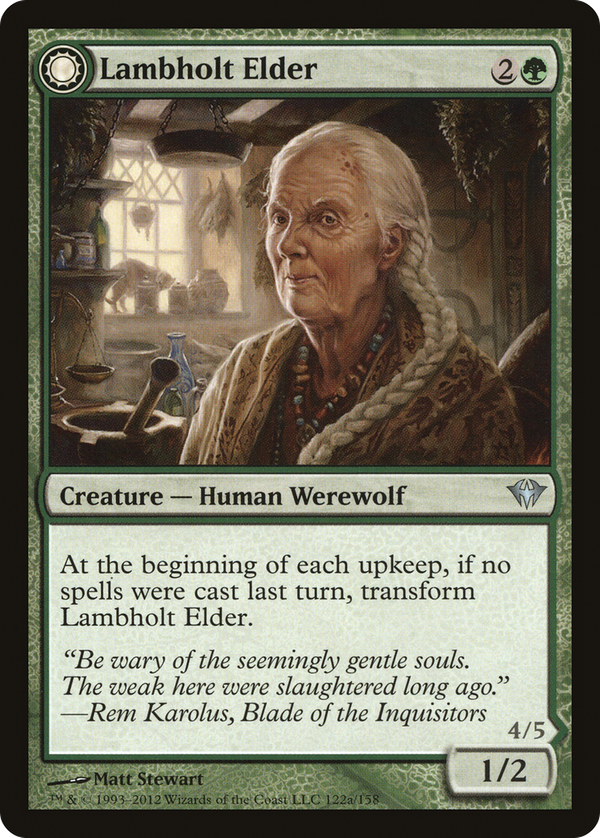
Lambholt Elder // Silverpelt Werewolf
Most of the early transform werewolves paid off the flip with raw stats: a meek front face that woke into a bigger body the moment the table went quiet. This one routes the silence into cards instead, and it does so on the back of connecting. The wolf side draws whenever it deals combat damage to a player, which means the whole design hinges on actually getting through. That is the catch worth naming up front: the back face has no evasion and only a modest body, so a clogged board shuts the engine off entirely. This wants open lanes, not a stalemate to break. The flip cadence follows the standard tribal rhythm, transforming forward on any spell-free turn and reverting only when a player casts two or more spells in a turn; the same condition the rest of the classic werewolves carry. What sets it apart is not the timing but the reward. Where most of the tribe converts a low-spell stretch into a swing of power, this one converts it into resource advantage, asking you to maintain board presence through grindy, quiet turns and then cash the wolf in for repeated draws. It rewards the patient, controlling pilot who can keep lanes clear and keep the spell count down: less a finisher than an attrition tool, and one that needs you to be winning the damage race before it does anything at all.