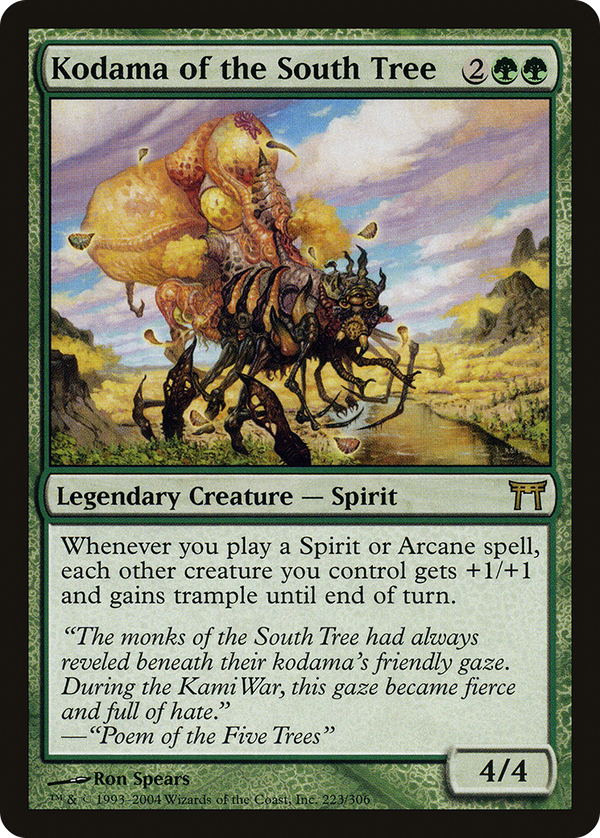
Kodama of the South Tree


Spirit-and-Arcane tribal asked a question most reward structures of the era never bothered with: what does it look like when an aggressive deck pays you for casting your own gameplan? The contemporaneous payoffs tended to key off your noncreature spells specifically, or an opponent's life total, conditions that pointed away from a creature-first board. This one keys off the bodies you are already deploying, turning every Spirit or Arcane cast into a board-wide pump that scales with how many creatures you have down. The trample clause does the heavy lifting that an ordinary anthem cannot: it converts a wide, mostly small board into damage that walks through blockers, so a one-mana Arcane instant cast mid-combat can be the difference between a chump-blocked attack and a lethal one. The catch is that the reward only fires for decks built around the theme: a pile of generic green creatures earns nothing, while a board stuffed with cheap Spirits gets a recurring, free combat upgrade. It sits atop the curve as both threat and engine, asking you to keep casting Spirits underneath it rather than hoarding cards. That self-referential shape, where your own spells buff your own board, is one the tribal decks of the period would chase repeatedly, but here the payload is pure aggression: a green four-drop whose whole job is to make a swarm hit harder the more it keeps doing what it was already going to do.