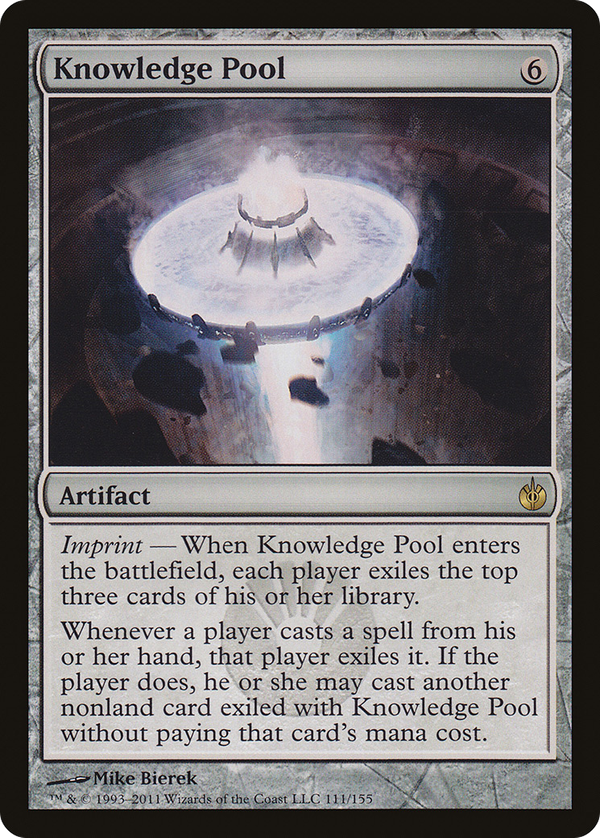
Knowledge Pool

The trick this artifact pulls is substitution, not denial: nobody loses the ability to cast spells, they lose the ability to cast their own spells. Every hand-cast spell goes into exile, and in its place the caster reaches into a shared pool of everyone's banished cards, all of them free. That single substitution rewires what a turn means. You are no longer playing a personal sequence of resources; you are gambling against a communal stack that your opponents fed. The cards sit there face up, so the pool is fully readable, which only sharpens the tension: you can see exactly what your last spell handed the table, and the next caster can see exactly what they get to steal. The symmetry is the design's whole nerve. It punishes whoever has the most explosive or expensive hand-castable spell, because that spell is now on offer to the whole room at no cost, and it favors the deck light on raw card advantage but heavy on disruption, or one whose plan does not route through the hand at all. Lands sidestep it entirely, since they are played rather than cast, which quietly tilts the lock toward the patient and the land-heavy. This is a particularly cruel flavor of stax: it does not stop spells, it scrambles ownership of them, turning a roomful of carefully assembled hands into a single chaotic library that pays out to whoever cast last. The imprint clause that exiles three cards on entry just seeds the pool so the chaos has somewhere to begin.