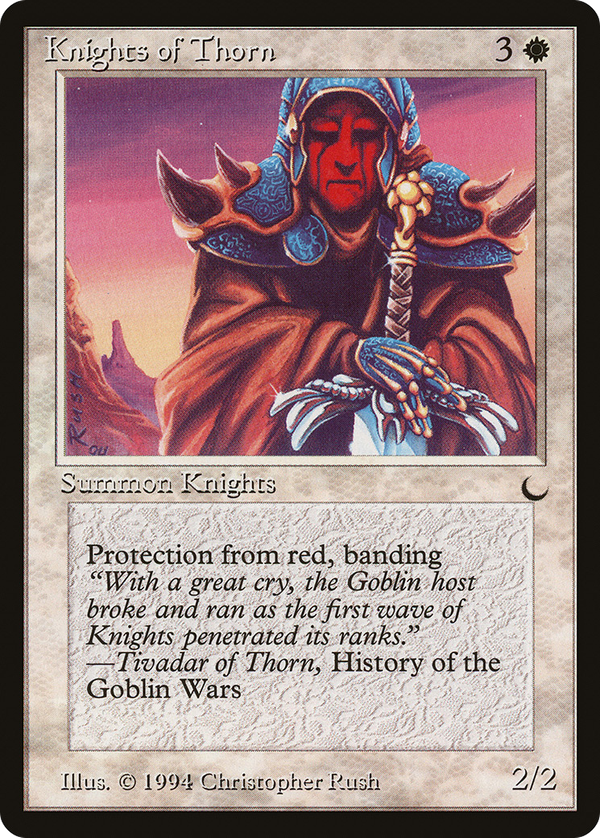
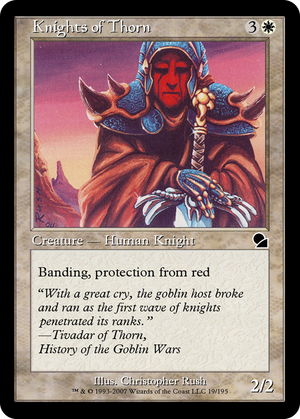
Knights of Thorn


A study in how early Magic stacked keywords without understanding how they would interact. Banding is the most labyrinthine combat mechanic the game ever printed: it lets a defender redirect and assign an attacker's combat damage, turning a blocking band into a damage-distribution engine that confused players for the better part of a decade. Bolt that onto protection from red, which prevents that damage, keeps red attackers from blocking it, and lets a 2/2 wade into red's burn and aggression untouched, and you have a creature whose rules text reads like a logic puzzle. The protection ability is the part doing real work: in the red-saturated early game, a body that could not be burned, could not be blocked profitably, and could rewrite a combat step through banding was a genuine wall against the most aggressive color. The banding clause is where the card earns its reputation for opacity; the interaction between a banding blocker and protection produces edge cases that the modern comprehensive rules spent considerable ink untangling. The card endures less as a playable creature than as a design lesson: it demonstrates why banding was quietly retired, an ability so powerful and so confusing in combination with evasion and protection that it never returned to a Standard-legal set after Magic's earliest years. A monument to a road not taken in combat design.