Knight of Dawn's Light


The lifegain replacement clause is the piece worth stopping on, because it changes math rather than adding a keyword. In white, incidental lifegain has always been the connective tissue of a certain kind of deck: soul-sister triggers, lifelinked attackers, small buffered gains that turn a race into an attrition grind. Bolting +1 onto every one of those events converts a passive drip into an engine, and it does so without asking you to name a payoff. The +1 is unconditional and applies to each separate lifegain event, not the turn's total, so a deck of many small independent triggers outperforms one built around a single large gain. That reframes deckbuilding around frequency: many small sources beat one big one. The rest of the card is deliberately modest scaffolding, a first-striking two-drop that can pump itself in a pinch, so the body survives combat and stays relevant in the mid-game without competing for the deck's real resources. What complicates the payoff is that the marquee ability rewards a build the knight cannot supply on its own; it wants a critical mass of lifegain around it, and it contributes nothing to that mass itself. That is the honest cost of the effect: a standalone card that only pays out in an ecosystem, offered at a rate cheap enough that assembling the ecosystem is the whole project.
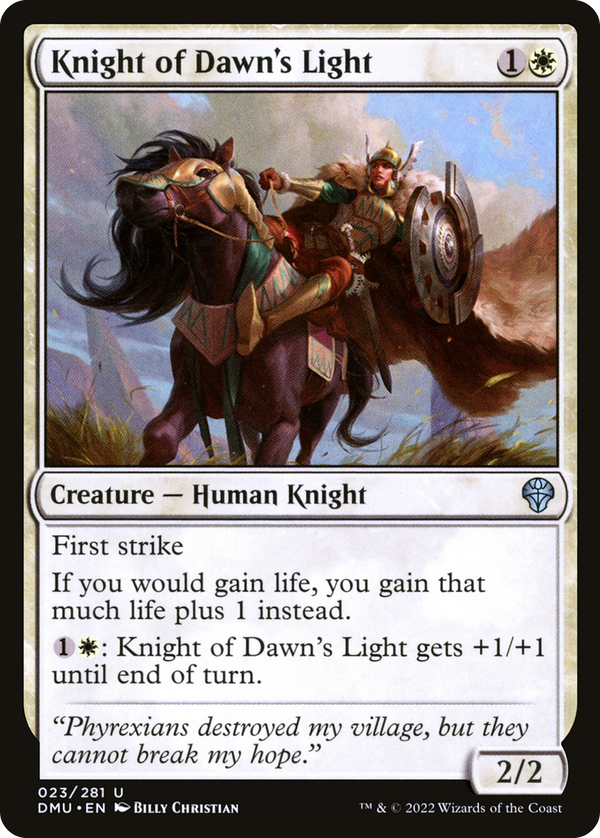
Rules text
: This creature gets +1/+1 until end of turn.