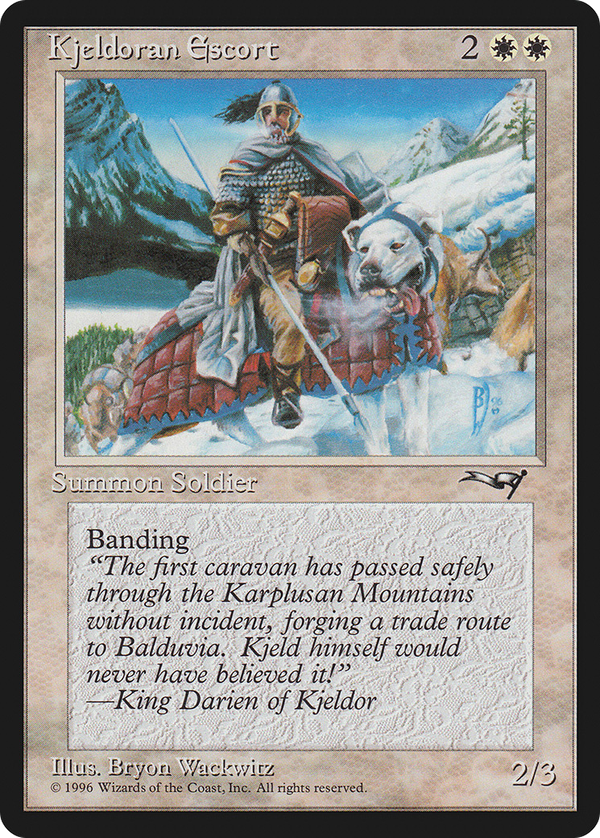
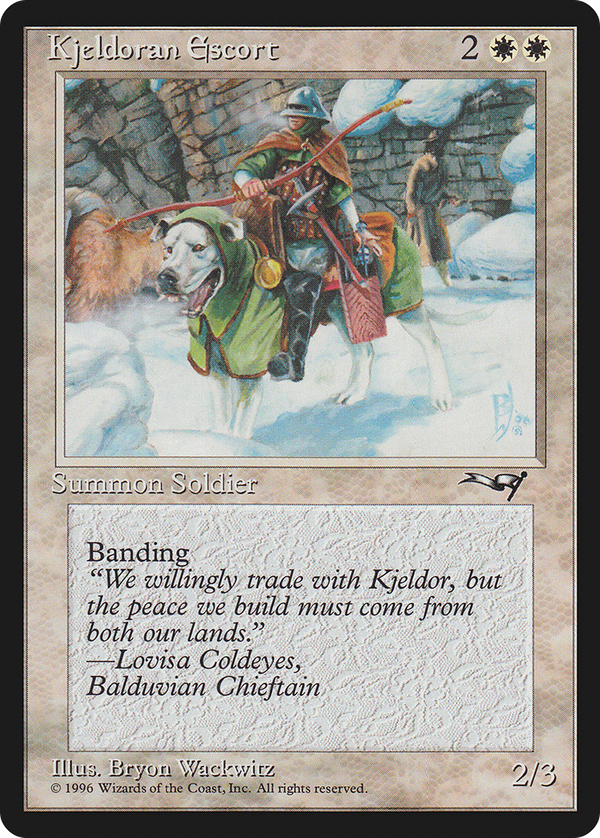
Kjeldoran Escort


Banding is the most notorious of Magic's early keywords, a rules-text labyrinth that even seasoned players had to read three times, and this is one of the unassuming commons that asked you to learn it. The ability does two distinct jobs welded into one word: on offense it lets your attackers move together as a single blocked group, and on defense it hands you, the blocker's controller, the right to assign the attacker's combat damage among your creatures. That second clause is the real prize. A 2/3 body that can soak a much larger attacker and then dictate where its damage lands turns this into a tax on aggression: an attacker has to commit far more than its size suggests to break through, because you decide which of your creatures eats the hit. White was the color of organized defense in this era, and banding was the mechanical expression of that identity, rewarding wide boards of cooperative soldiers over single threats. Wizards eventually retired banding from new design precisely because of cards like this one: the damage-division rules generated more table arguments and rules-lookups than the gameplay justified. What remains is a fossil of a design philosophy that prized intricate combat math over clean templating, the kind of card that taught a generation that the scariest thing on the battlefield was sometimes a small white creature with a paragraph of reminder text.