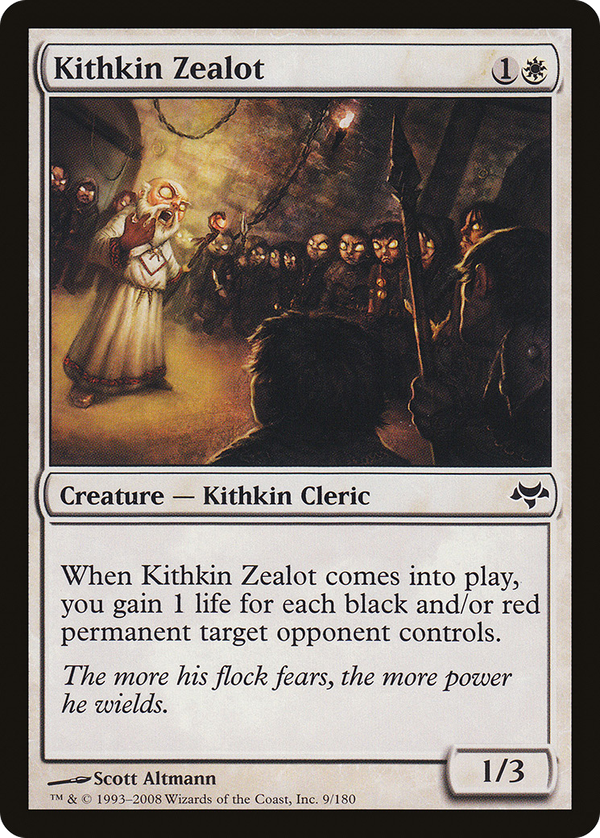
Kithkin Zealot


The lifegain here scales off your opponent's commitment rather than your own board, and the conditional clause is the whole tell: it counts black and red permanents specifically, the colors an aggressive white deck is most likely to be racing. The reward is calibrated to the matchup, not to combat. Against a tapped-out Rakdos or mono-red board that has dumped its hand onto the table, the life gained on arrival can buy a real turn or two; against a control mirror or any opponent with none of those colors in play, the trigger looks for something to hate and finds nothing. That volatility is the design working as intended. Cards built to answer a specific color pairing are supposed to sit idle when the pairing is not across the table, and this one wears its narrowness openly. The 1/3 body confirms the intent: it is a wall, a blocker that survives combat against the one- and two-power attackers those fast decks lean on, and the banked life is meant to extend the clock in exactly the games where extending it matters. It belongs to white's long tradition of asymmetric anti-aggression tools, the family of cards that gain life off opposing pressure, except this one prices its payoff to the metagame rather than to the attack step. When the metagame cooperates, it is a meaningful swing; when it does not, it is a static defender that read the opposing colors and came up empty.