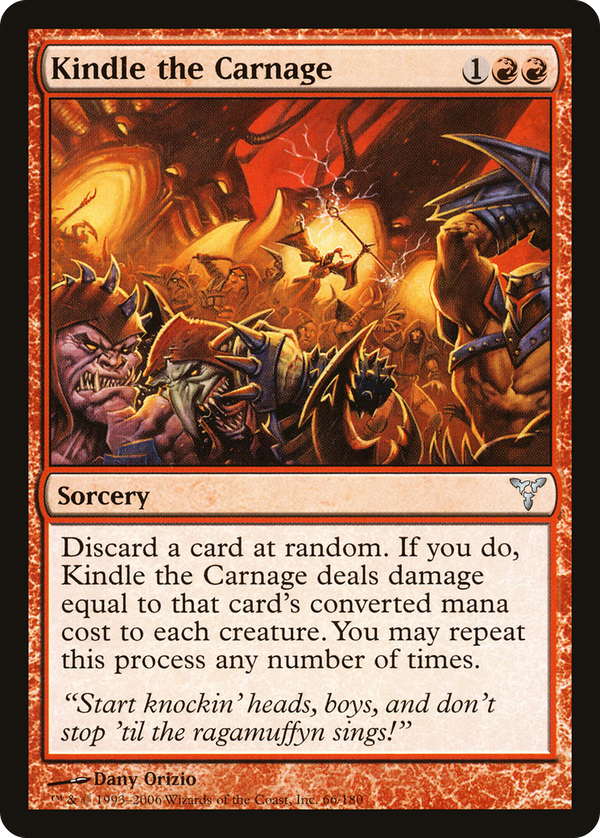
Kindle the Carnage


The hook is the gamble: you do not choose how much damage you deal, the top of your hand does. Each iteration peels a random card and converts its mana value into a board-wide damage tick, and you decide only whether to pull the trigger again, never which card feeds it. That makes the spell a study in deck construction as variance control. Run it in a deck full of cheap one and two-drops and it sputters, a sweeper that whiffs into singles. Stock it with expensive bombs and fatties you are happy to ditch, and a single chain can crater both your hand and the opposing board in one pass. The repeat clause is the wrinkle that lifts it past a fixed-damage wrath: there is no ceiling, only the diminishing supply of cards to discard and the dawning math of whether the next flip clears the thing that matters. Red rarely gets to play executioner against an entire board at sorcery speed, and the genre usually pays for that privilege with self-damage or a flat number. Here the cost is informational chaos: you are sacrificing card advantage and hand security for a sweeper whose size you can only steer, not set. It rewards a builder willing to treat their own hand as ammunition and accept that some fraction of the time the gun jams.