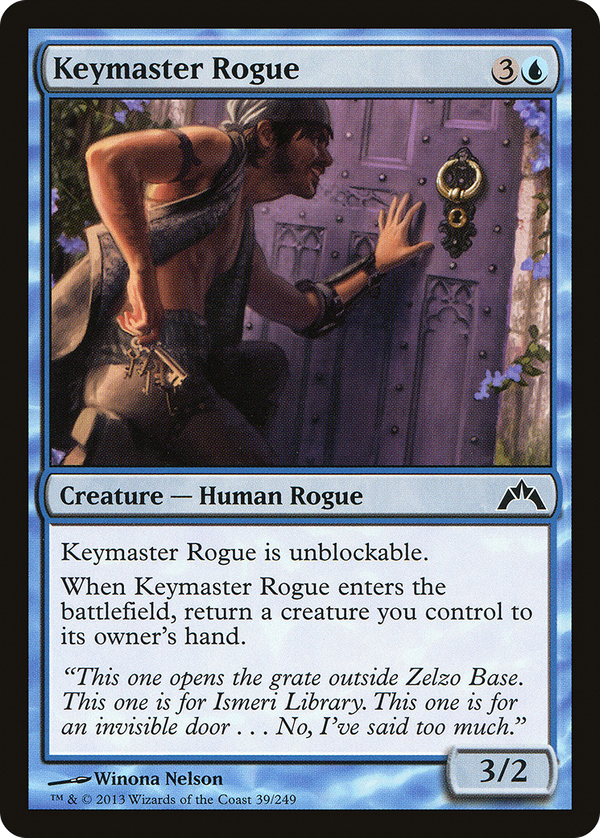
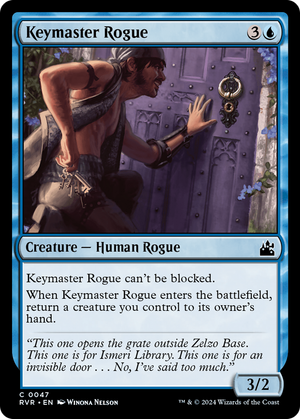
Keymaster Rogue


The bounce clause is the price, not the payoff. An unblockable 3/2 for four would be unremarkable on its own; the enters-trigger that forces a creature back to hand is the cost that keeps that rate in check, and it is also what turns the card into an engine rather than a liability. The return has no opt-out, so it asks you to always keep a body that profits from going home: a creature whose own enters-trigger you would happily replay, or Keymaster Rogue itself, returned to hand by the next copy in a loop that recurs whatever your other pieces do on entry. Evasion stapled to a recursion enabler is the real design idea. Pushing damage and asking to be flickered are usually two separate jobs on two separate cards; folding both onto one body makes the unblockable damage the floor and the chained entrances the ceiling. The fragile frame reinforces the plan: a body that pushes a few points through, then gets picked up by its own kind, leaning the whole package toward tempo and value rather than beatdown. Crucially, the bounce is a one-time entrance condition, not a pseudo-blink you can fire at will, so the value comes from chaining new copies and stacking enter-the-battlefield effects, not from saving this creature in combat.