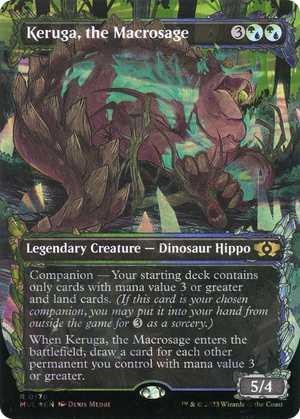
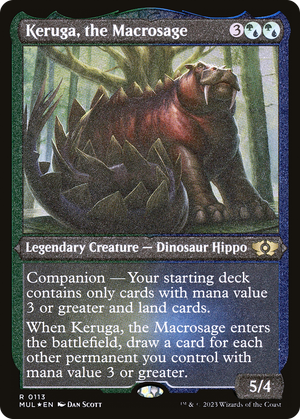
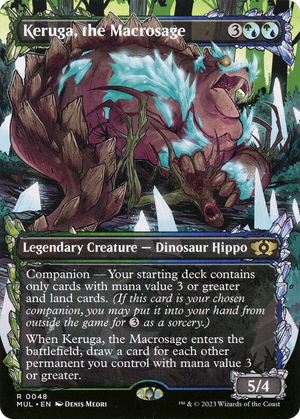
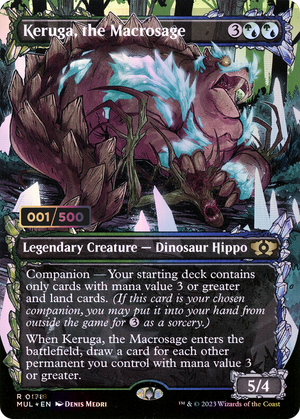
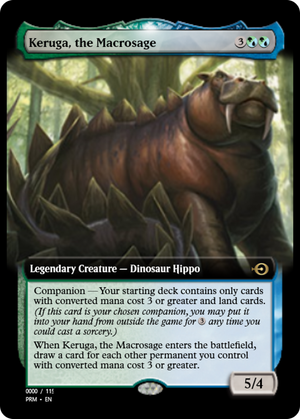
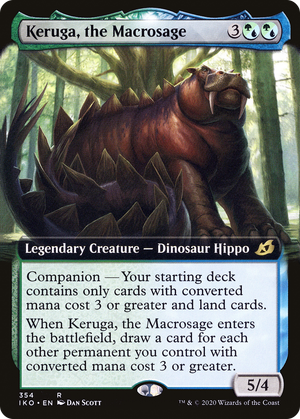
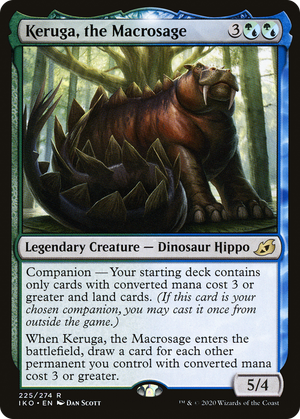
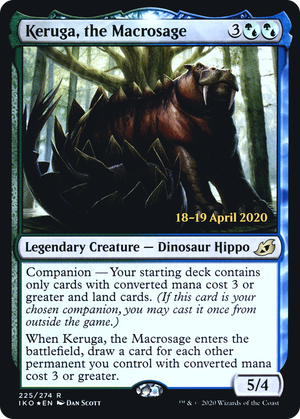
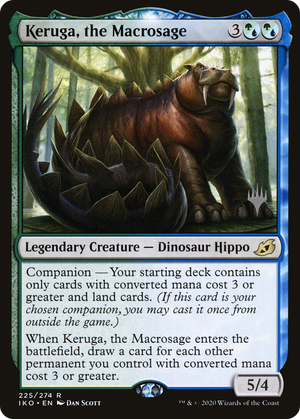
Keruga, the Macrosage


The companion clause is a deckbuilding tax dressed as a payoff: it forbids nonland cards with mana value 2 or less, stripping out the cheap interaction, the one-drops, the two-mana ramp, and asking whether a deck can function with a curve that starts at three. Lands are the explicit exception, called out by name in the restriction alongside the mana-value-3-or-greater cards, so a mana base survives intact while the interactive spells do not. Most decks cannot pay that price, which is why Keruga lives in a narrow corner: control and ramp shells that already sat above the curve, rewarded with an extra card summonable from outside the game for a restriction they were half-honoring anyway. The enters trigger scales off the same threshold the companion condition enforces, so the two halves reinforce each other; build to satisfy the requirement and the draw pays out on its own. Of its companion cycle, this is the one that changes the least about how you play once it resolves: card advantage stapled to a 5/4 body, with no loop or flicker attached. It also stands as evidence for why companions were reined in. A card available every game from the sideboard warps deckbuilding math in a way a maindeck card cannot, and the errata that added a hand-cost to every companion is what pulled Keruga back from free value to a resource you actually spend.
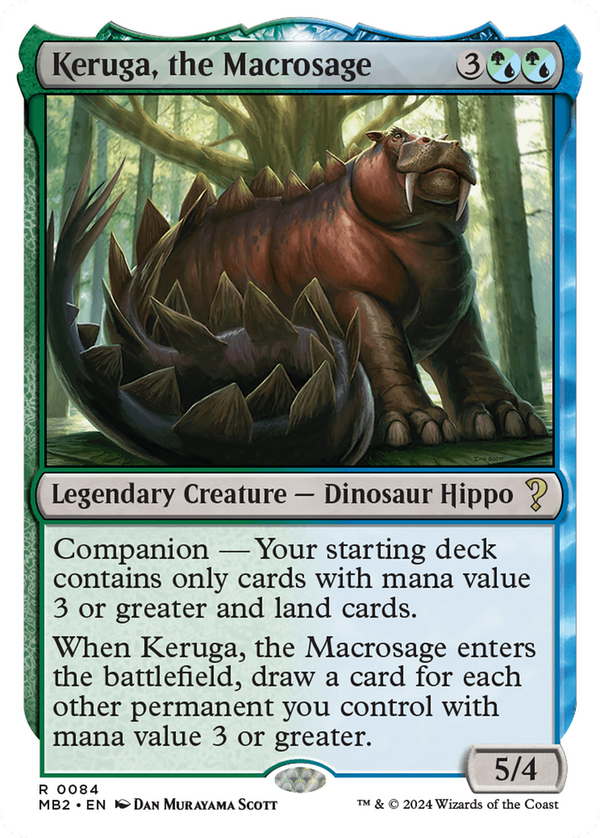
Rules text
as a sorcery.)
When Keruga enters, draw a card for each other permanent you control with mana value 3 or greater.Format Status
More formatsFewer formats
Other printings
- Multiverse Legends#178
- Multiverse Legends#113
- Multiverse Legends#48
- Multiverse Legends#178z
- Magic Online Promos#80847
- Ikoria: Lair of Behemoths#354
- Ikoria: Lair of Behemoths#225
- Ikoria: Lair of Behemoths Promos#225s