Keeper of the Light

A lifegain engine built around a condition that defeats its own purpose. The activation only works while an opponent has more life than you, which means every point you gain pushes you closer to the threshold where you can no longer gain. It is a rubber band, not a ramp: the card is designed to keep a falling-behind player tethered, not to let a winning one run away. That self-limiting clause is the entire design discipline. The tap symbol does the rest of the rate-limiting work, capping the effect at a single three-life swing per turn under normal circumstances, so even a desperate player cannot vacuum back a full life deficit in one pass. Without that gating, a three-life-per-turn sink would have been a soft lock against an aggressive draw; with it, the effect is tied to a deficit you actually have to be in. The "choose target opponent" wording is residual flavor from a multiplayer-aware era of design, where which seat is ahead of you matters; in practice it just confirms that the ability checks a specific opponent's life total rather than the table's. This is the kind of card that reads as a value engine until you trace the arithmetic and realize it is a brake pad: useful precisely when you are losing, inert the moment you are not. The gating-on-deficit template is an unusual restraint, an answer to the design problem of how to give a control deck a stabilizer without handing it an unkillable life lead.
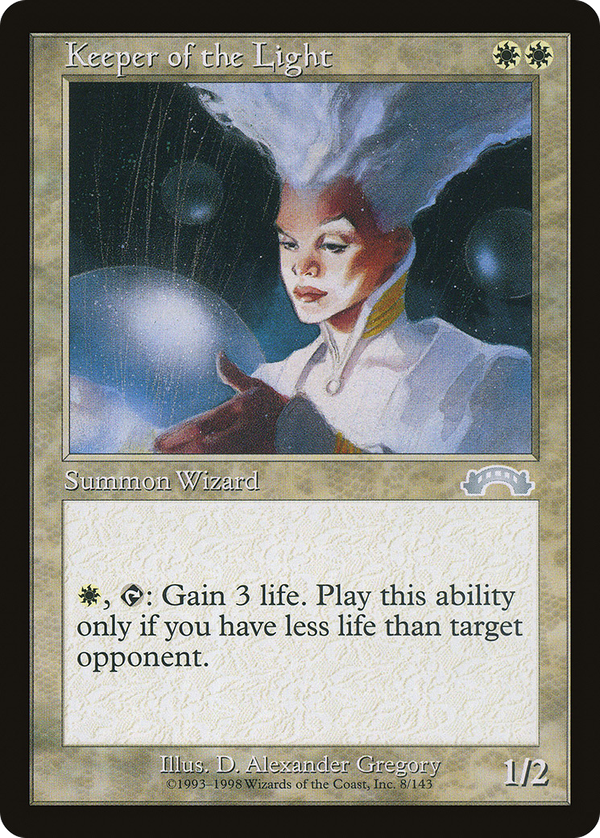
Rules text
,  : Choose target opponent who has more life than you do as you activate this ability. You gain 3 life.