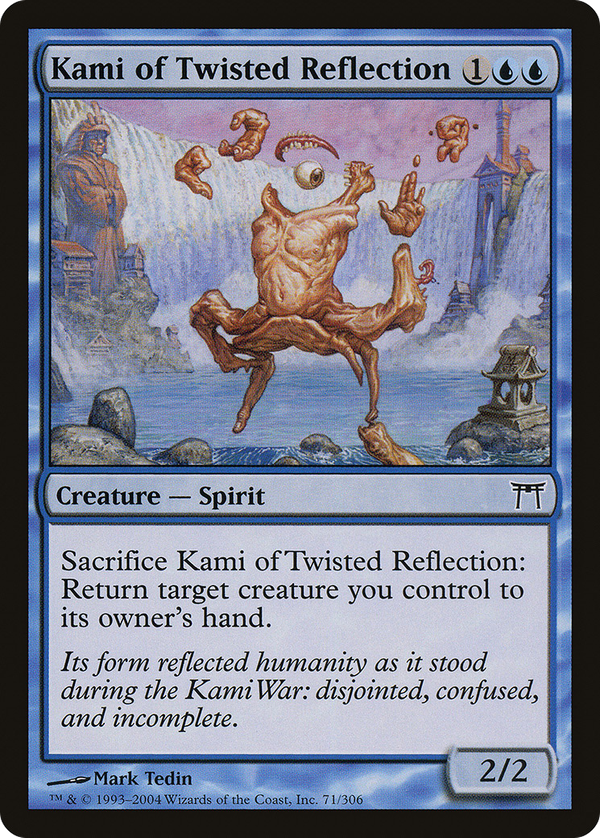
Kami of Twisted Reflection


The bounce is pointed inward: not a tempo play against an opponent but a way to reset your own enters-the-battlefield triggers, dodge targeted removal, or save a creature from a board wipe by sending it home before the spell resolves. As a Spirit body it slotted into the soulshift web that defined blue-black tribal designs of its era, but the activated ability is what gives it a second life. Reread it as an engine piece rather than a fog-and-go combat trick and the design tension comes into focus: the sacrifice is a cost, not a drawback, because it feeds death triggers, fills a graveyard, and clears the way for a fresh recast of whatever value creature it returns. The catch that keeps it honest is that the body has to disappear to fire, so each activation is a one-shot conversion of one Spirit into one bounce; you cannot loop it without an outside way to bring it back. That self-contained quality is exactly why later sacrifice-to-bounce designs tended to push the effect onto cheaper enablers or attach it to recursion. Here the work is split cleanly down the middle: a creature you can cast on curve, and a saboteur of your own board state when the moment demands it.