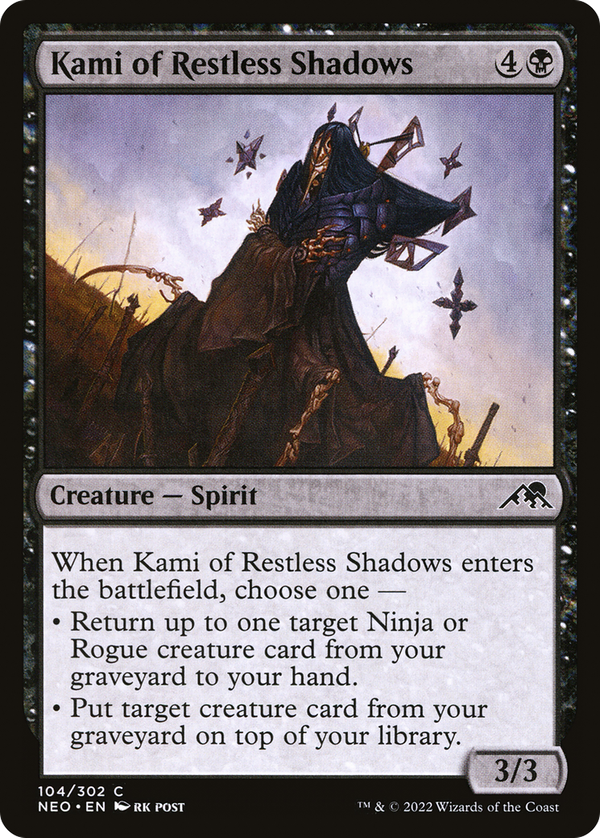
Kami of Restless Shadows


The modal split names its own audience: one clause serves a specific tribe, the other serves any creature deck at all. The first mode buys back a Ninja or Rogue, refueling the recursion loop that ninjutsu shells run on when their small evasive threats trade off in combat. The second is the broader tool, seeding your next draw with any creature card in the yard, converting a used-up body into a card you have already lined up without inflating your hand. Both modes work along the same axis: they treat the graveyard as inventory rather than a discard pile, and both pay off for a deck that has already committed to putting creatures there. The 3/3 body is deliberately plain, and that plainness is the cost accounting: the card pays for its recursion by arriving at five mana and offering a single enters-the-battlefield trigger instead of a repeatable engine. Return-to-hand is the higher-tempo line for the Ninja and Rogue build it was tailored to; the library-stacking mode is the tribe-agnostic fallback, so a hand without the right creature types still gets value from casting it. It reads as a role-player because it is one: a body plus a choice, sized to slot into a tribal recursion plan without demanding the rest of the deck bend around it.