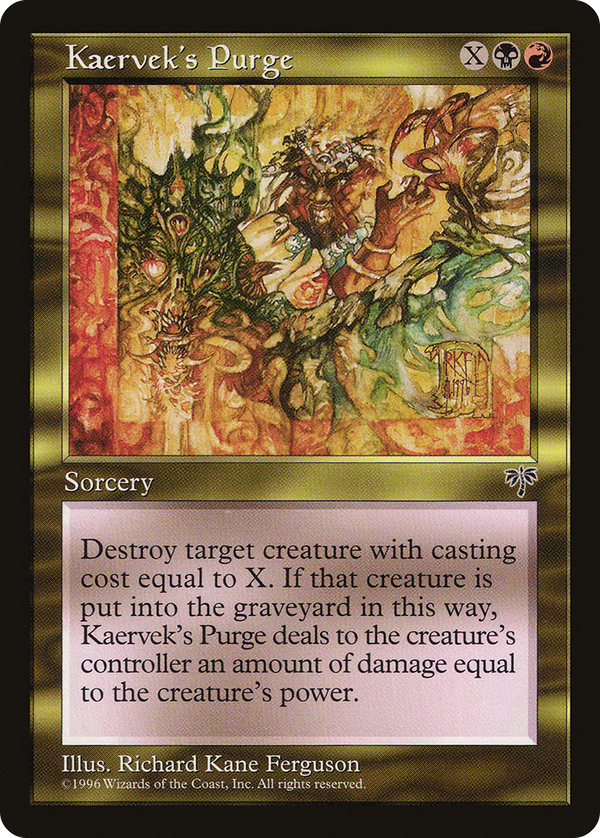
Kaervek's Purge



The X in the cost sets the price and it sets the lock simultaneously: you choose X on cast, and that number dictates which creature you can legally point at, so the spell only ever fires at a target whose mana value you have already committed to matching. That declared-value constraint is what earns the rider. A plain destroy effect at this cost would be unremarkable; what justifies bolting on the punisher half (damage to the controller equal to the dead creature's power) is that the burn rides on a removal spell that already made you pay for the size of what you are killing. Big creatures cost more X to remove and hit their controllers harder when they fall, so the spell scales its reach and its punishment in lockstep. This is the conditional removal the era leaned into: spells that asked you to read the board precisely rather than hold a blanket answer, where the cost itself encoded the board state. The black half supplies the kill, the red half supplies the burn, and the X clause chains them: you cannot scale up to threaten the controller without first paying to clear the threat, and a cheap creature with high power can still extract a big swing of damage. The size of the answer is set by X, while the size of the payoff follows the destroyed creature's power.