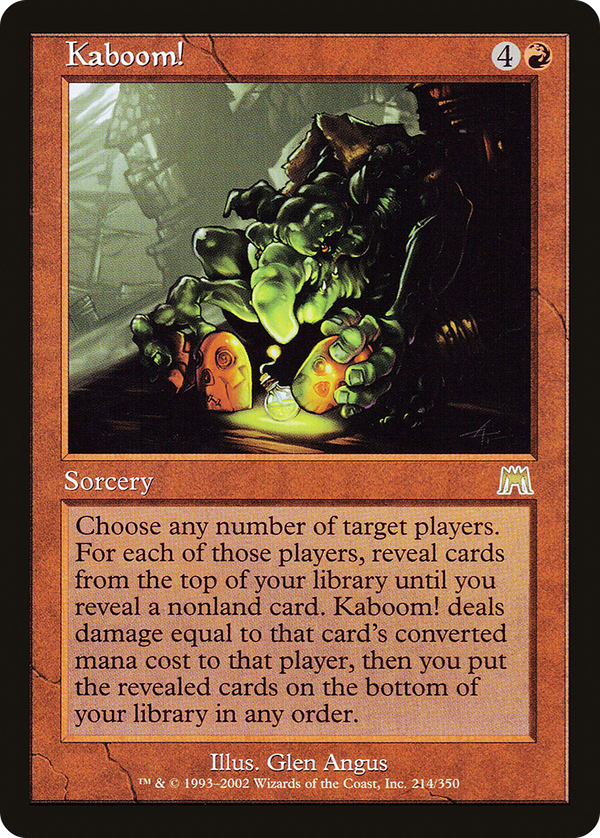
Kaboom!


Variance dressed up as a payoff. Damage equals the mana value of the first nonland card you flip, so the spell rewards a deck stuffed with expensive top-end while punishing the curve that would actually want to cast a five-mana sorcery in the first place. Hit a six-drop and you bolt a player for an obscene amount; hit your two-mana enabler and you've spent five mana to deal two, then buried the rest on the bottom of your library to do it again. That tension is the whole gamble, and it makes Kaboom! a worse Fireball most of the time and a wildly better one occasionally. The multiplayer dimension is where the design actually breathes: choosing any number of players or planeswalkers means each target gets its own independent reveal, so a single cast can spray different amounts of damage around the table from separate cuts of the library. It belongs to an early era's taste for theatrical randomness rather than to any disciplined burn plan. The bottoming clause is the quiet honesty in it: you don't draw the revealed cards, you put them under the deck in any order, so the spell costs you nothing but time and gives you no card selection in exchange for the chaos. What you're buying for five mana is not reach but a slot machine, and the appeal has always been the pull of the lever rather than the expected value behind it.