Juzám Djinn


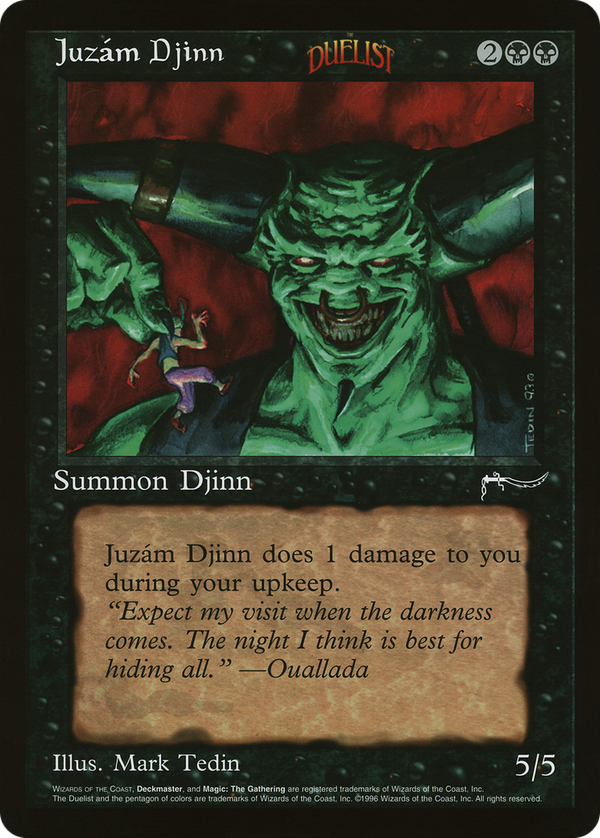
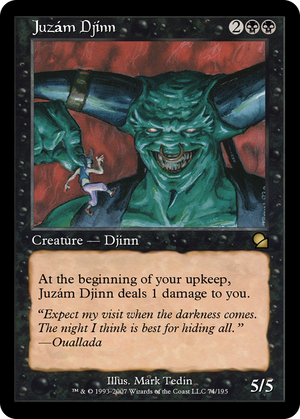
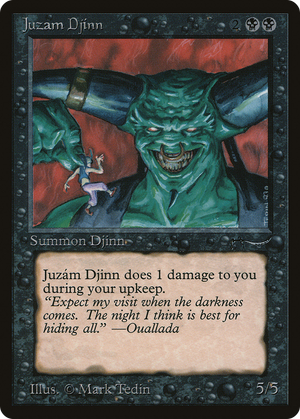
The benchmark for efficient black beaters, and the card that taught Magic what a downside is supposed to look like. Four mana for a 5/5 was, in 1993, an absurd rate: the era's vanilla scaling priced a body that size closer to six or seven mana, and the closest white-bordered comparison points came saddled with crippling restrictions (Juggernaut had to attack each turn; Sengir Vampire cost five and only grew through kills). The upkeep ping is what makes the rate work, and it is a remarkably clean piece of cost engineering: the drain scales with the length of the game rather than the power of the card, so the aggressive deck that wants the 5/5 barely notices it while the controlling deck that would abuse it pays a real tax. That single-line drawback became a template Wizards returned to for years (Carnophage and Sarcomancy both owe something to it), and the broader principle (overstat the body, charge the difference in life) is now the load-bearing assumption behind most of black's pushed threats. Mark Tedin's art carries the card's weight too: the grinning, cigar-smoking djinn is one of the few pieces of early-era iconography the brand has never tried to redraw. Because the card sits on the Reserved List and has never received a paper reprint, that single image is the only one it has ever carried, which has done as much for its mystique as the stat line.