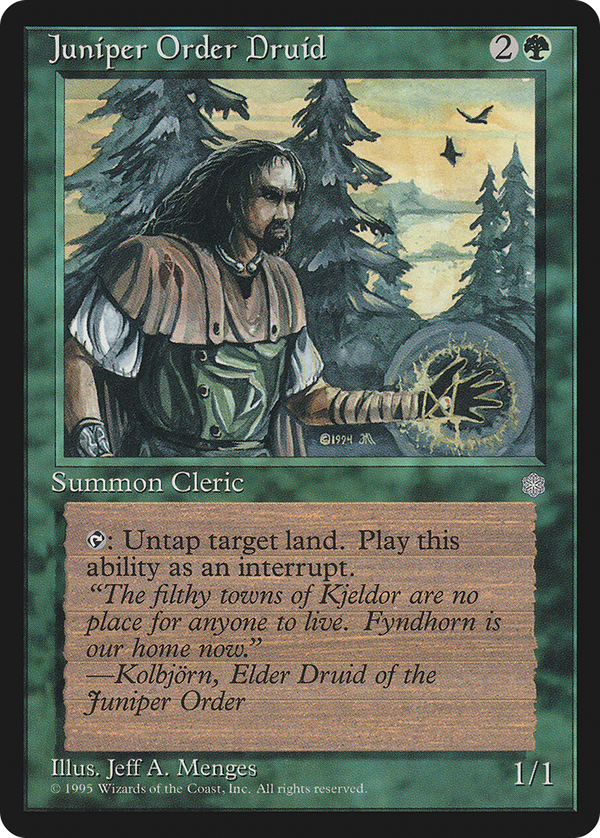
Juniper Order Druid


The key difference between this druid and a mana dork is that it produces nothing on its own: it doubles down on a land you already control, so its value scales entirely with how good that land is. Point it at a basic and you have a slow, fragile Llanowar Elves variant that nets one extra mana per turn at best. Point it at a land that taps for more than one mana, or one carrying an ability worth re-triggering, and the druid becomes a way to wring that land for double duty each turn. The arithmetic is harsh either way: paying for a 1/1 that installs one extra mana per turn only breaks even over a long game, and only if the body survives. That patience is the design point. Green ramp in this period asked you to wait, treating incremental advantage as a real resource rather than a rounding error, and a fragile tapper with no haste has plenty of ways to die before it earns back its investment: any removal, any combat exchange, any answer at all shuts it off mid-payment. It represents a school of green deckbuilding where slow, fixed-output engines were the cost of admission to acceleration, and where the upside lived in finding the right land to point at rather than in the creature itself.
Rules text
 : Untap target land.