Journey to Oblivion


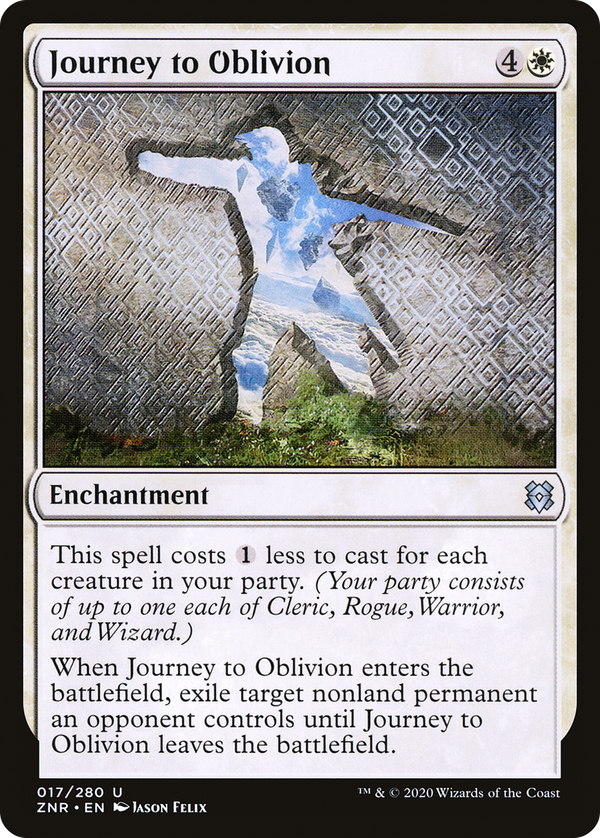
Oblivion Ring taught white a durable trick: turn any removal into a temporary exile the enchantment holds hostage, answerable only if the opponent can break the enchantment itself. This welds that template onto party, and the weld is the entire idea. At face value it is a five-mana enchantment, a slow and clunky answer no serious deck would run at that rate. But each creature filling one of your four class slots trims the cost, so a build assembled to field the full party lands it near the price of a genuine interactive spell while the exile clause stays flat and unconditional. That is the tension worth noticing: the removal effect asks nothing about what it kills, and the discount asks everything about the board you already committed to. It answers a planeswalker, a problem artifact, or a threatening creature with equal indifference, the catch-all white has always wanted from its enchantment removal; the tribal discount is simply the toll for making a floor-five card behave like a floor-one card. Left unbuilt-around, it is dead weight. Built around, it expresses cleanly what party was for: rewarding a deck that pays the tribal tax up front by handing it efficient effects on the back end. The class-count subsidy does the structural work that spectacle or delve does elsewhere, cheapening a fixed effect for a board state you were already assembling.
Rules text
 less to cast for each creature in your party. (Your party consists of up to one each of Cleric, Rogue, Warrior, and Wizard.)
When this enchantment enters, exile target nonland permanent an opponent controls until this enchantment leaves the battlefield.
less to cast for each creature in your party. (Your party consists of up to one each of Cleric, Rogue, Warrior, and Wizard.)
When this enchantment enters, exile target nonland permanent an opponent controls until this enchantment leaves the battlefield.