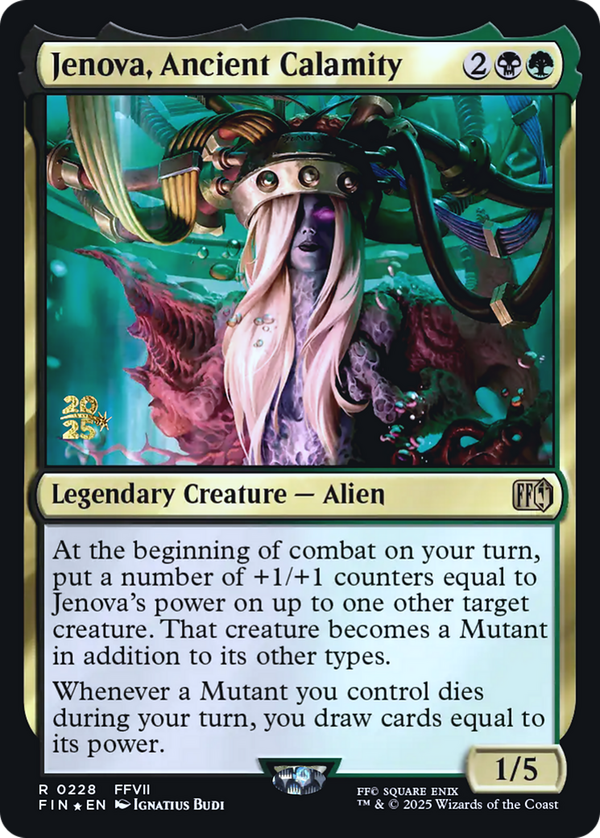
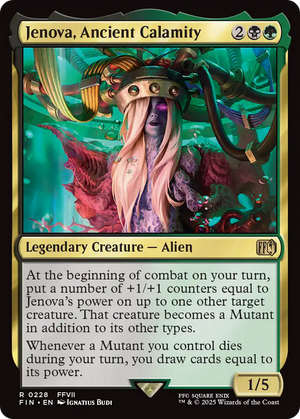
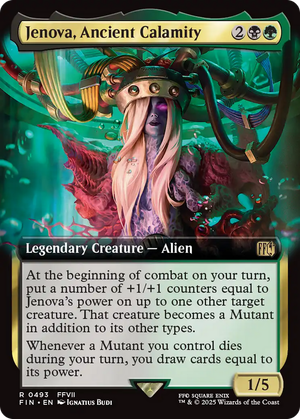
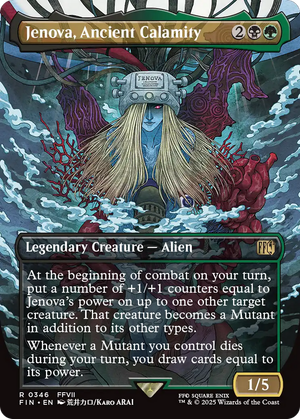
Jenova, Ancient Calamity



A 1/5 body that reads like a defensive brick is really the trigger housing for a graveyard-value engine wearing a +1/+1 counter costume. Each combat, it plants counters equal to its own power on a chosen creature, and because that base power sits at 1, the default deposit is a single counter per turn: the number only climbs if you buff the source itself. That deliberate modesty matters, because the counters are not the payoff. The tagging is. Marking the buffed creature a Mutant converts it into a stored draw payload, since when a Mutant you control dies during your turn you draw cards equal to its power. Suddenly the creature you have been growing is worth exactly as many cards as you were willing to let it get before spending it.
That inverts the usual counter logic. Most +1/+1 payloads want the counters to stay planted and keep swinging; this one is content to lose the body, because losing it on your turn is the cash-out. The loop wants sacrifice outlets and expendable bodies, and it wants combat trades you time yourself: pump a Mutant, let it die on your turn, refund a hand. The 5 toughness is the governor, keeping the engine alive to fire again while the 1 power ensures its own attack never carries a game. The reward scales with patience: the longer you feed a Mutant before releasing it, the deeper the draw.