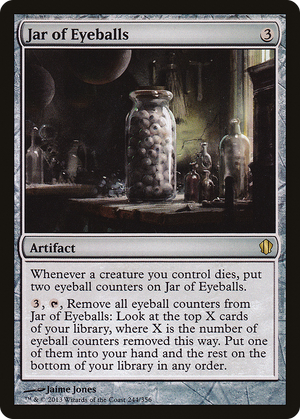
Jar of Eyeballs

The fantasy is that your own creatures dying becomes sight rather than loss: every death drops two eyeball counters, and the jar converts that grief into card selection. The trouble is the conversion rate. The whole pile cashes out at once for exactly one card, dumping the rest to the bottom of your library; the counters never make multiple cards, only a deeper look at the top before you keep a single one. That structure punishes both patience and impatience. Crack it after a single death and you are sifting two cards for a meager payoff against six mana of total commitment (three to play, three to activate); wait for a second death and four cards, still one keeper. Hoard counters across a long grind and you finally get a genuinely wide dig, but you have spent many turns and many dead bodies to net one card. The design sits in an awkward middle: it wants a sacrifice-heavy board to feed it, yet it gives nothing back fast enough to power a board that is actively trading away. It is best understood as a slow, repeatable selection engine for a graveyard-agnostic attrition deck, one content to let the eyeballs accumulate while the real plan happens elsewhere. The flavor (a literal jar collecting the eyes of the fallen, the more you have lost the farther you can see) is sharper than the rate the card actually delivers.
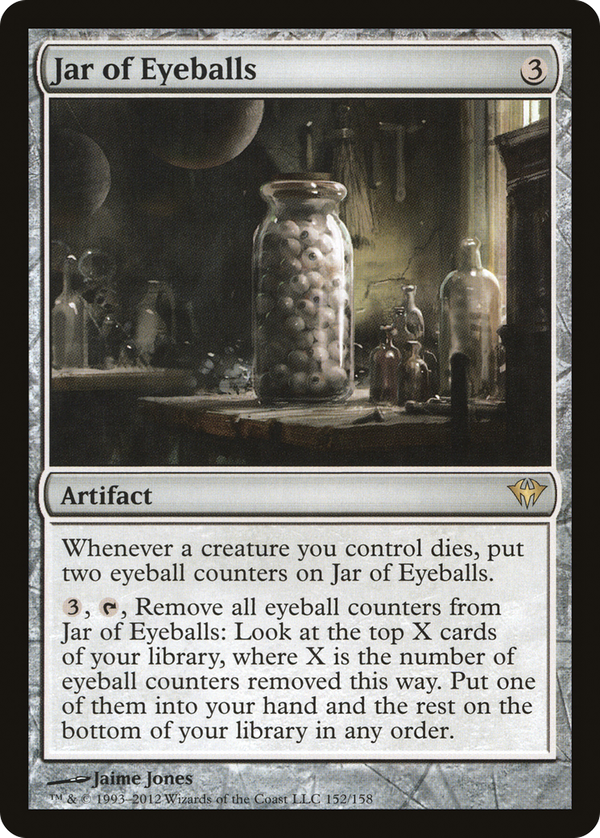
Rules text
,  , Remove all eyeball counters from this artifact: Look at the top X cards of your library, where X is the number of eyeball counters removed this way. Put one of them into your hand and the rest on the bottom of your library in any order.