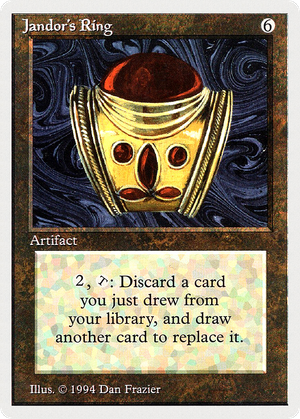
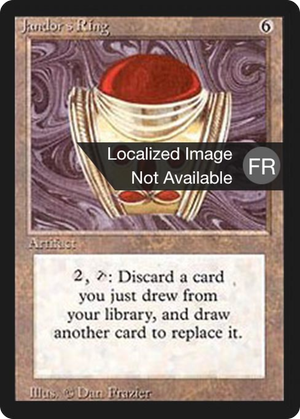
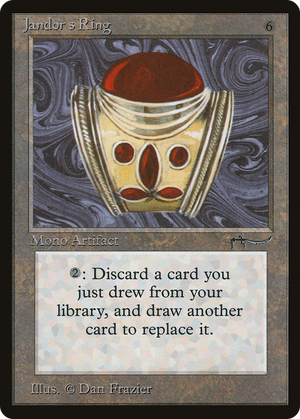
Jandor's Ring

Six mana for the artifact and two more per activation to swap the last card you drew for a fresh one off the top: nothing about that math has ever been competitive, and the obsolescence is exactly why the card rewards a second look. This is a 1993 design solving a 1993 problem, treating card selection as a luxury good and pricing it like one. The activation hinges on a constraint modern players rarely consider, the "last card you drew this turn" clause, which forces you to commit to the discard before you see what comes next and effectively caps the ability at one use per draw step under normal sequencing. That clause is the entire balancing mechanism, and it is why the card reads as a curiosity rather than a staple: this is filtering, not advantage (you trade one card for another and end where you started, only fresher), so the loop never generates the edge that would justify the mana to assemble it. Sensei's Divining Top later answered the same design brief (repeatable, artifact-based card selection) at a fraction of the cost and without the discard tax, and the gap between the two measures how far the design language traveled in the intervening years. As a relic of the era when even sifting through your own deck carried a premium, it earns its place as a reference point far more than as a card anyone casts.
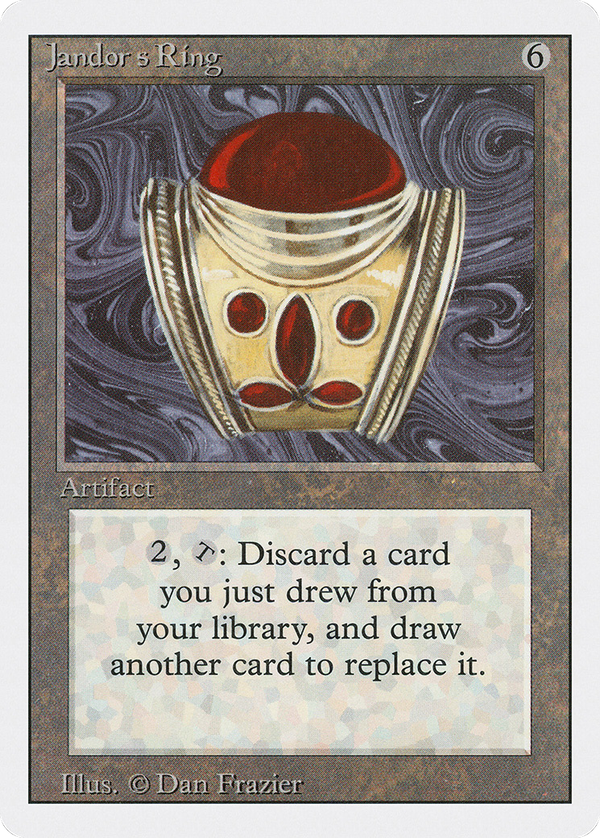
Rules text
 ,
,  , Discard the last card you drew this turn: Draw a card.