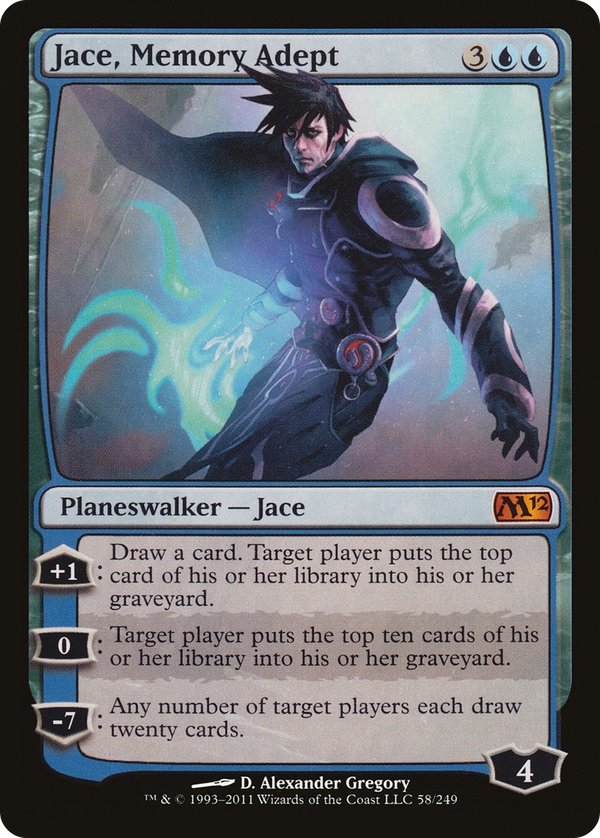
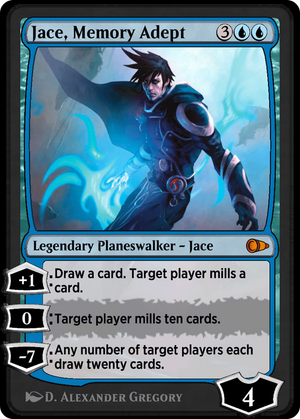
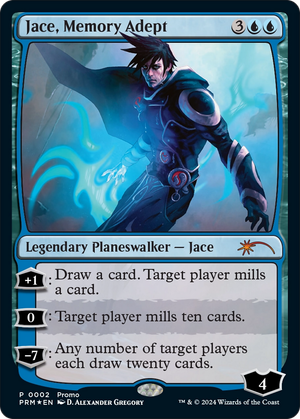
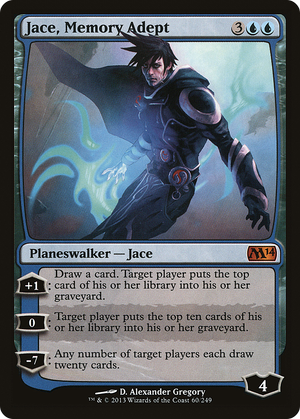
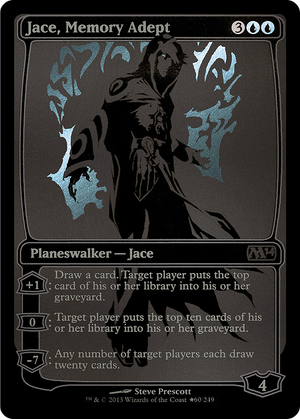
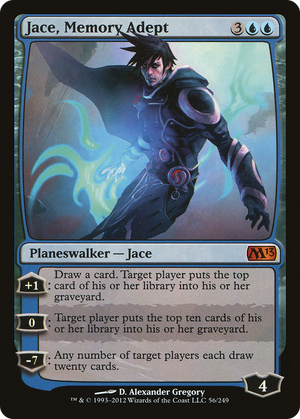
Jace, Memory Adept


The card that made mill a self-contained win condition rather than a fragile race against your own beatdown clock. The zero ability does the heavy lifting: ten cards per activation, fired without spending loyalty, which means the library can be ground away every turn while the planeswalker sits untouched at its starting four. That is the design tension Wizards keeps circling whenever a mill payoff gets evaluated. A free-to-fire engine that ends games has to come stapled to a kit that does little else, so the plus ticks up only a single loyalty for a modest draw-and-mill, and the ultimate is a Howling Mine writ enormous that you point at one opponent and no one else: "any number of target players" lets you hand twenty cards to a single library already ground low and leave your own untouched, which is usually just a slower way to deck someone you were going to deck anyway. The result is a planeswalker that does exactly one thing and does it relentlessly: it turns the opposing library into a resource you spend down to zero. Protecting it means choosing the plus instead, climbing one loyalty at a time toward a minus-seven you rarely need to reach. Mill builds before this leaned on assembling pieces and praying to outrace the aggressor; here was a single permanent that did the work itself the moment it was safe to fire. Every dedicated mill centerpiece since has been measured against this template: a self-sufficient engine that asks nothing of the rest of the deck except time.