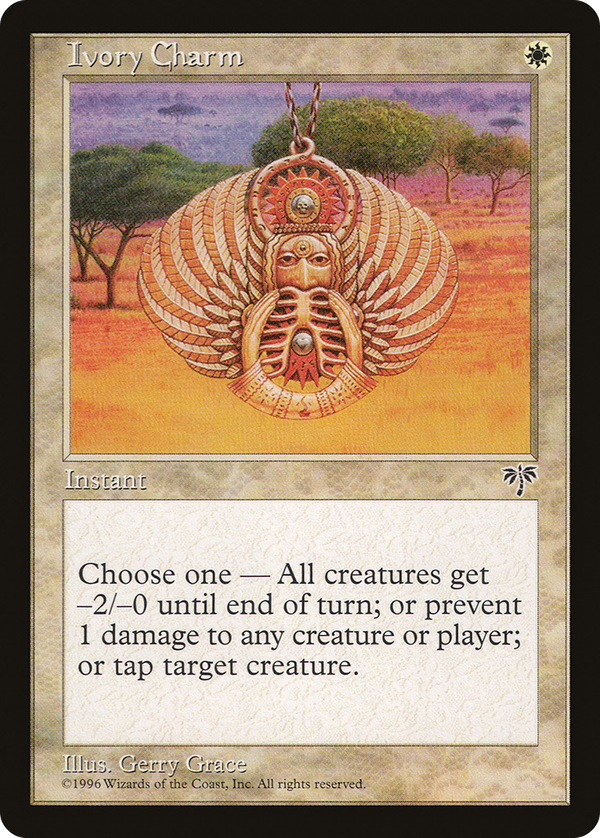
Ivory Charm

Mirage's charm cycle was an early experiment in cramming flexibility into a one-mana common, and the white entry is the most defensive-minded of the five. The three modes share a theme of buying time rather than swinging tempo: a battlefield-wide power dampener that blanks an alpha strike, a single-target tap to break up a swing or hold back a blocker, and a one-point prevention shield that does less than a fog. None of the modes wins a game on its own, which is the design point. The charm is a one-mana hedge, a card you keep open to answer whatever the turn presents without committing to a specific answer in your opening hand. The -2/-0 mode in particular is the kind of toughness-agnostic effect that white has largely moved away from; modern white combat math leans on prevention and damage redirection rather than shaving power off the whole board at instant speed. The cycle reads as the moment Wizards started pricing modality at common, accepting that three weak options bundled together can earn a slot that any one of them alone could not. The charms taught the design team something durable about how to value flexibility, and the lesson outlasted the cards themselves.