Invincible Hymn


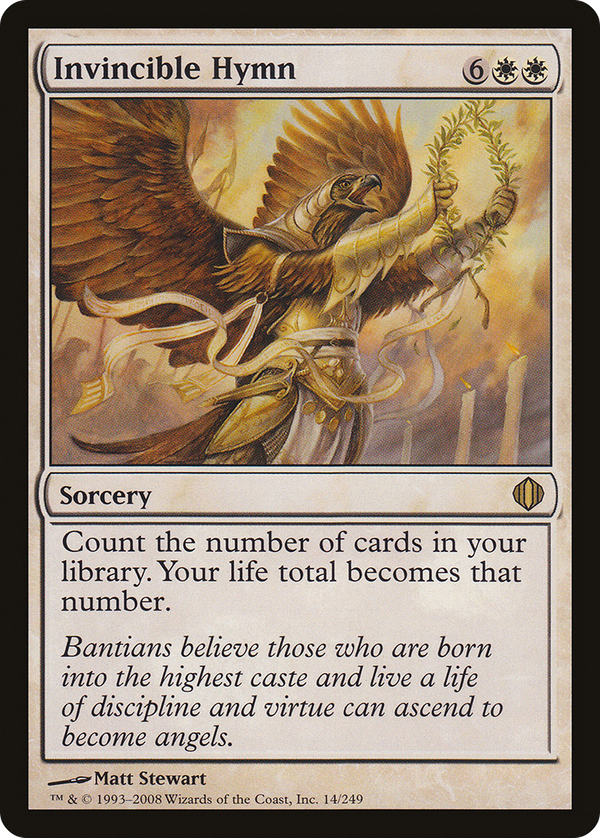
The whole engine is one transaction: trade the height of your library for your life total, set rather than accumulated. The number it pays out is decided by your draw step, not the spell itself, and the math runs backward from how most life gain works. A full sixty-card list that has barely drawn hands you fifty-plus life; a library worn down by a long game leaves you with a sum that may be worse than where you started, because the deck only ever shrinks. That inversion is the tension. Eight mana for "your life total becomes X" reads as a finisher, but it buys time, not lethality: it asks for a separate payoff that turns a mountain of life into a win condition rather than a stalemate. So the deck that rewards it is the one that gets here early, with cards still stacked, then converts that buffer into pressure (a life-to-damage drain, a fast clock the cushion protects). The deck that grinds, draws deep, and arrives late is the one it punishes, because each card it has dug for is a point of life this spell will no longer find. The clean white precedent is life as a number you declare rather than a pile you build, and the design space (life banked in your draw pile, spent down the moment you start digging) has stayed narrow precisely because that one-to-one conversion punishes the very digging that long-game decks are built around.