Inquisitor's Flail

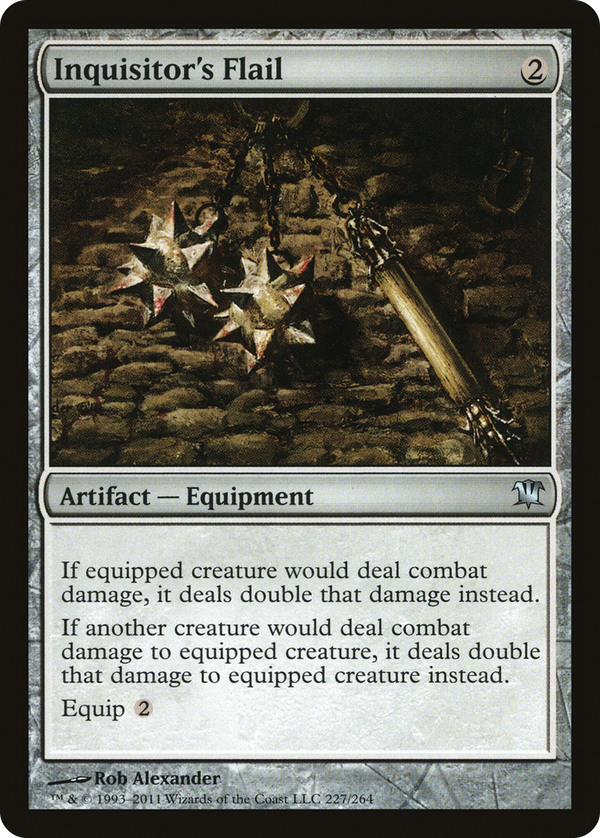
Most damage-doublers are pure upside dressed up as a drawback: a downside written small enough to ignore. This one means it. The second clause is symmetrical and unconditional: whatever blocks or is blocked by the equipped creature deals double damage right back, so the same equipment that turns a 4/4 into an eight-damage swing turns it into a creature that dies to a 2/2. The doubling applies to combat damage in both directions with no escape hatch, no "only on your turn," no exclusion for the equipped creature's own clause. That symmetry is the whole design contract: it sells a glass-cannon outcome at two mana to cast and two more to equip, and asks the wielder to keep the creature out of trades where the doubled return damage is lethal. The clean home is first strike, which collapses the symmetry entirely: the equipped creature deals its doubled damage before the blocker ever swings, killing all but the largest defenders before any retaliation lands. Deathtouch helps the swing connect but does nothing for survival, since simultaneous combat damage means the doubled retaliation still arrives. It also reads as a deterrent. Opponents do the math and decline to block, because trading into a doubled striker is rarely a profitable exchange. The interesting tension is that the card is most dangerous when nobody fights it, which is the opposite of how a combat trick usually earns its keep.
Rules text