Indatha Crystal

The three-color version of a design pattern that goes back to the original artifact mana rocks: a colorless-cost stone that taps for a fixed slice of the color pie, here the white-black-green wedge. What distinguishes this generation of fixing from the diamonds and signets before it is the cycling clause, and that clause is the whole reason a card this slow earns a slot. A rock that only ever ramps is dead weight the moment the game stops needing mana; drawn late, flooded on lands, stuck in a hand that has already curved out, it does nothing. Cycling for two converts that dead card into a fresh one, which means the deckbuilder is never fully punished for running it. The design trades raw speed (it enters tapped, effectively, in the sense that it is a full turn behind a two-mana rock) for a floor that most fixing lacks. That is the tension it resolves: fixing wants to be flexible enough to run without regret, and a rock that can become any other card in the deck is exactly that. It is not fast and it is not flashy; it is the fixing you include precisely because it refuses to ever be a blank.
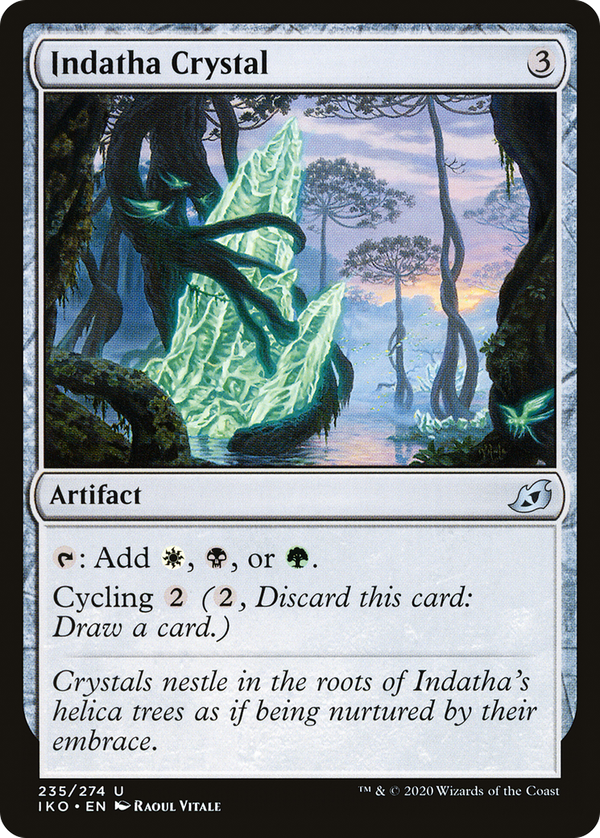
Rules text
 : Add
: Add  ,
,  , or
, or  .
Cycling
.
Cycling  (, Discard this card: Draw a card.)