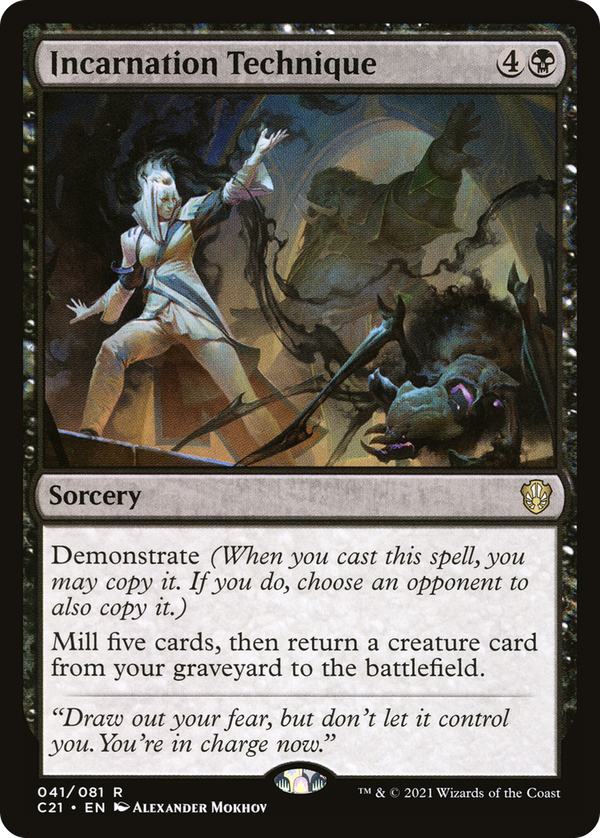
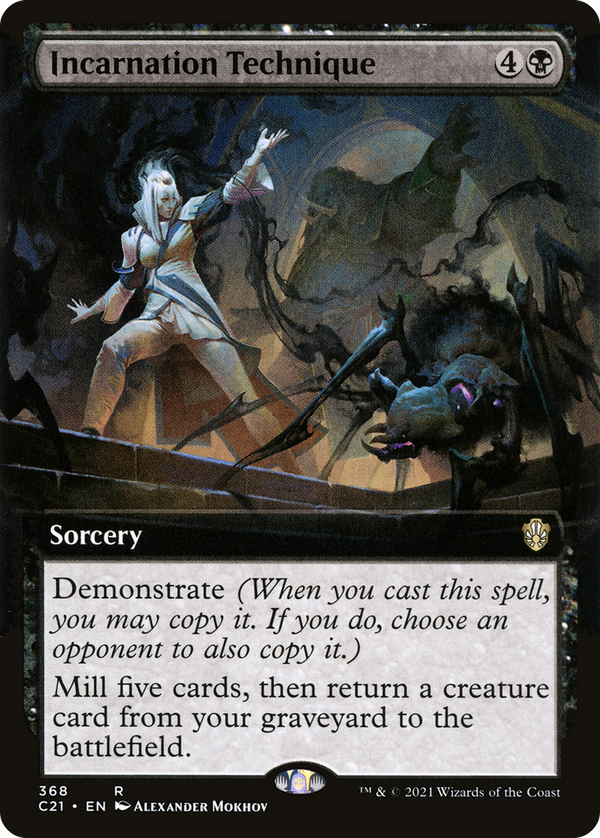
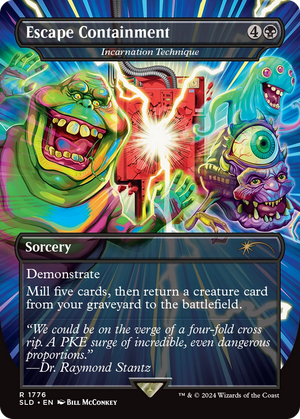
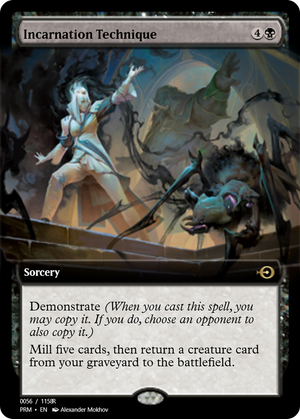
Incarnation Technique


Reanimation has always been a solitary act: fill your own graveyard, pay for your own resurrection, and keep everyone else locked out of your bin. Demonstrate breaks that assumption by handing the mill-and-reanimate package to an opponent as the price of copying it for yourself. Each player who takes a copy mills their own five and returns a creature from their own graveyard, so the card only doubles your reanimation by first arming someone else's. That symmetry is the whole calculation: you copy when your graveyard holds the better target and the stocked libraries make the mill worth the risk, and you keep the spell to itself when the opponent you would hand it to has more to gain. Unlike the older single-target reanimation line where the milling and the recursion sit in separate cards, this folds the setup and the payoff into one cast, filling its own bin five cards deep before pulling from it, which turns an empty graveyard into a live target on the same turn. The tension is entirely in the demonstrate clause: the raw effect is a self-sufficient reanimation spell, and the copy is a political lever that trades a mirrored gift for a doubled return. Whether that trade is worth making depends on reading the graveyards across from you before the spell resolves, not after.