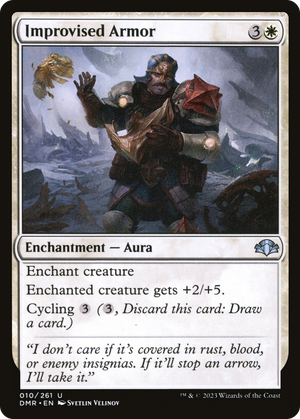
Improvised Armor


Cycling is what saves an Aura like this from being a dead draw, and an entire common-rarity spell base of its era was built around exactly that bargain. A four-mana enchantment granting +2/+5 is unremarkable on rate: it makes a blocker enormous and turns an attacker into a wall, but it commits a card to a permanent that dies with its host, the structural risk every Aura carries. The cycling clause answers that risk before it ever arrives. When the game wants a fattened wall to stop a ground assault, you pay it out as written; when the board has gone wide and your creatures are dead or irrelevant, you spend three and trade the dead Aura for a draw step instead. That optionality is the actual product here, not the +2/+5. The +5 toughness skews the buff toward defense, which tells you the slot it was built for: a blocking creature that needs to survive combat and trade up, padding life totals in the slower white decks of its age while the cycling cost keeps the card from clogging an aggressive draw. It belongs to a design philosophy that treated every card as having a floor, and the floor for a defensive Aura that might never find a worthwhile target is precisely a single card drawn for three mana.
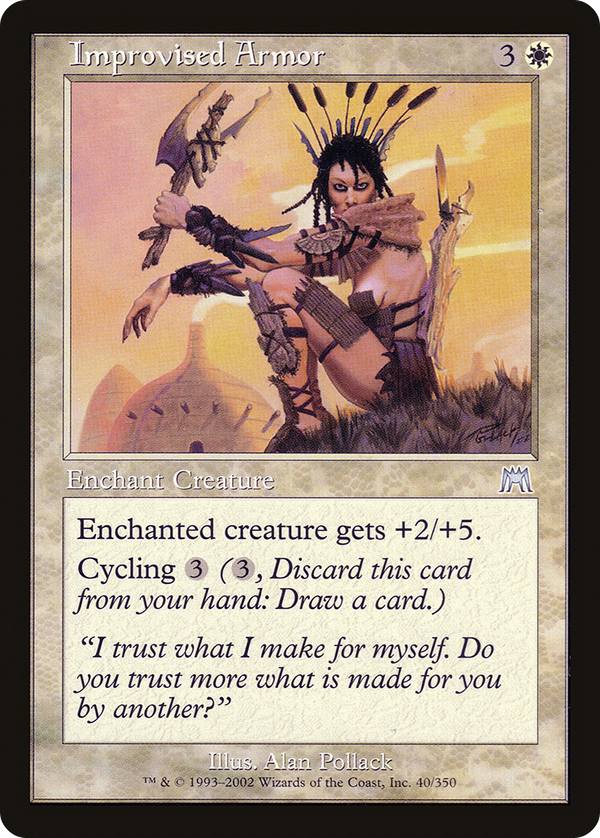
Rules text
(, Discard this card: Draw a card.)