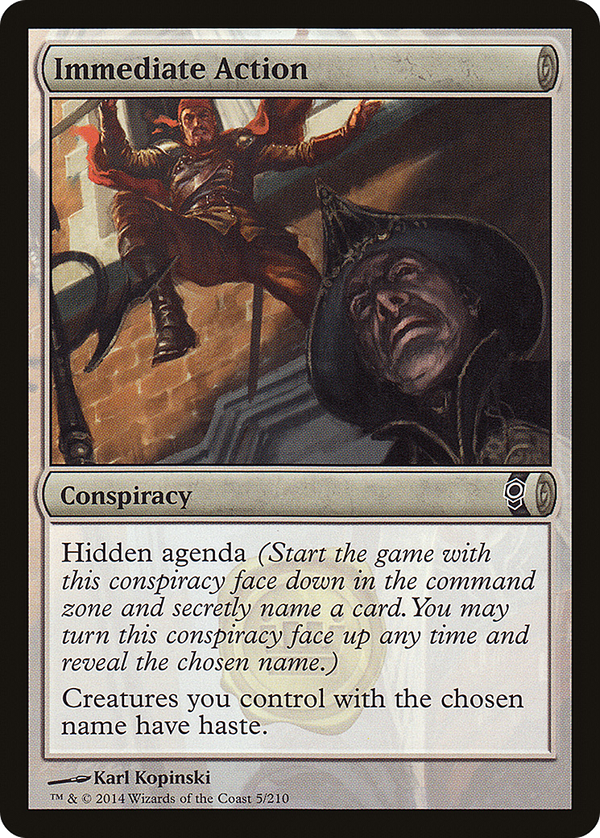
Immediate Action
Hidden agenda turns a deckbuilding choice into a bluff played against the table: you start with this conspiracy face down, name a card in secret, and flip it whenever the moment is right. The wager here is unusually steep relative to its payoff. The secret it protects is haste, the cheapest and most replaceable keyword in the game, an ability red creatures hand out for next to nothing on their own. So the mechanic does nearly all the work; the value lives not in what the chosen name gains, but in withholding which name you are protecting until you reveal. The reward shape favors naming a card you expect to play in multiples (a token-maker, a recursive threat, a creature you mean to cast straight off the top), so the haste lands on the turn the body would otherwise sit summoning-sick. The structural problem is disclosure asymmetry. With the other Hidden agenda conspiracies, a revealed name reshapes how opponents block and trade: knowing a creature now has double strike or menace changes everything about combat math. Revealing that a creature has haste tells opponents only that it was already coming. This is the conspiracy whose hidden information changes the least once shown, attached to a payoff that an aggressive red deck mostly generates for free. The bluff is real; what it is hiding is not worth much when the cards turn over.