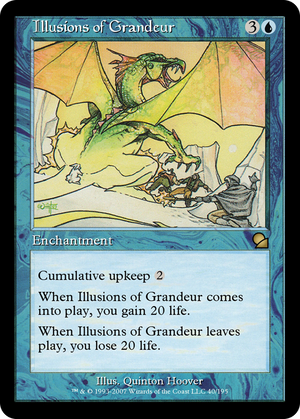
Illusions of Grandeur


A loan, not a life total. The 20 life is the lure; the escalating upkeep is the interest, and the 20-life loss on departure is the balloon payment that comes due the moment you stop paying rent. Left in your own deck, the card is a clock counting down to your own death: pay 2, then 4, then 6, then more, until the arithmetic collapses and you sacrifice it back into a 20-point swing against yourself. What makes it singular is that the gift and the obligation cannot be separated by ordinary means, and the famous trick was to separate them anyway. Donate it to your opponent (Donate being the standard partner) and the entire structure inverts: they inherit the upkeep bill, they take the 20-life loss when it falls off, and the 20 life you gained up front simply stays with you at the worst possible moment for them. That two-card interaction anchored an entire combo archetype built around forcing an unwanted enchantment across the table. On its own, the card is a literal accounting of delayed cost: Ice Age priced powerful effects on a sliding scale, charging more for each turn you cling to the benefit, and few cards in that mechanic make the trap as plain as a number that giveth and a number that taketh away. The whole thing is engineered to be regretted, by whoever ends up holding it.
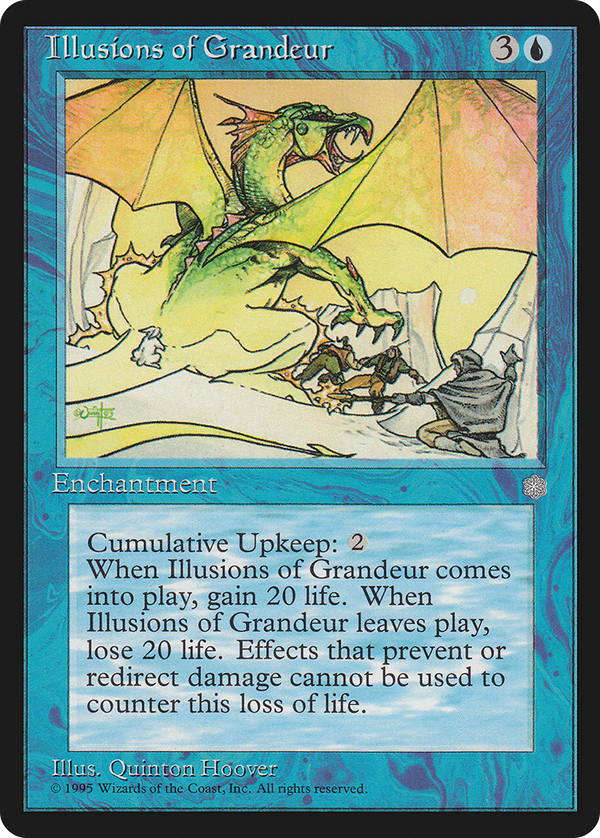
Rules text
 (At the beginning of your upkeep, put an age counter on this permanent, then sacrifice it unless you pay its upkeep cost for each age counter on it.)
When this enchantment enters, you gain 20 life.
When this enchantment leaves the battlefield, you lose 20 life.
(At the beginning of your upkeep, put an age counter on this permanent, then sacrifice it unless you pay its upkeep cost for each age counter on it.)
When this enchantment enters, you gain 20 life.
When this enchantment leaves the battlefield, you lose 20 life.