Illusionary Terrain

Name two basic land types as the enchantment enters, and every basic of the first type becomes the second: an opponent's Plains turn into Islands they cannot tap for white, or your own scattered colors get hammered together into a single source. This was Wizards betting that warping the type line of basic lands could be a tournament lever, a slow form of color denial delivered by an enchantment rather than by a Stone Rain to the face. The static effect is one half of the design; the payment schedule is the other, and it is where the card spends itself. Cumulative upkeep climbs by two generic each turn, so the enchantment that costs two to cast asks for two on its first upkeep, then four, then six, the meter starting the turn after it lands. That curve dictates the play pattern: drop it to strand a color for a turn or two, then let it fall off once the tax outruns whatever the disruption was worth. Ice Age built much of its mechanical voice around these self-terminating costs, and Illusionary Terrain wears that identity plainly, an effect leashed by a payment clock that guarantees it leaves on its own. The land-hosing axis it tried to open never grew into anything lasting, but the card records how Magic metered an ongoing effect back when finality counters and cleaner tools did not yet exist to make the same argument with far less bookkeeping.
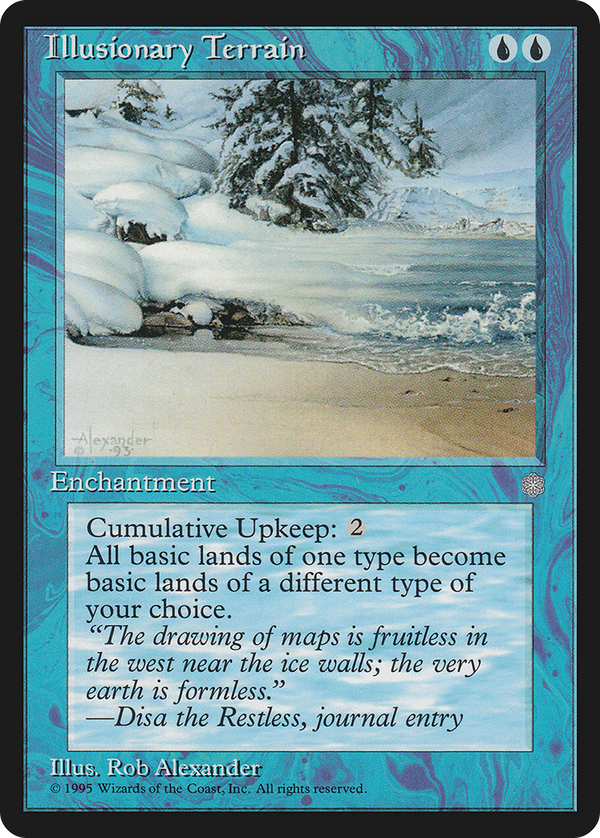
Rules text
 (At the beginning of your upkeep, put an age counter on this permanent, then sacrifice it unless you pay its upkeep cost for each age counter on it.)
As this enchantment enters, choose two basic land types.
Basic lands of the first chosen type are the second chosen type.
(At the beginning of your upkeep, put an age counter on this permanent, then sacrifice it unless you pay its upkeep cost for each age counter on it.)
As this enchantment enters, choose two basic land types.
Basic lands of the first chosen type are the second chosen type.