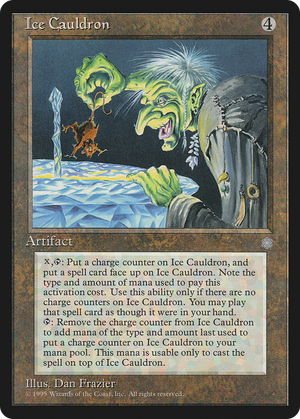
Ice Cauldron

The most baroque mana-storage rig the game ever printed, and a monument to a school of design Wizards has since abandoned: the card that asks you to track state across two separate activations and forbids you from making a mistake. The first ability banks a card and the exact mana you paid (type and amount, noted down like an accountant's ledger); the second ability gives that mana back, but only to cast that one exiled card. The charge-counter gate means you run one cycle at a time, so there is no engine here, no loop, just a clumsy way to defer a single spell by a turn and convert mana of one moment into mana of another. The friction is the entire experience. You are remembering what colors you spent, remembering which card is locked under the artifact, and remembering that the restricted mana evaporates if you point it anywhere else. Modern templating would never ship this: the bookkeeping lives in the player's head rather than on the battlefield, and the payoff does not come close to justifying the cognitive tax. It survives as a curiosity from an era when "complicated" and "deep" were treated as synonyms, and as a favorite puzzle for rules pedants who enjoy that the noted mana can include things mana usually cannot.
Rules text
 ,
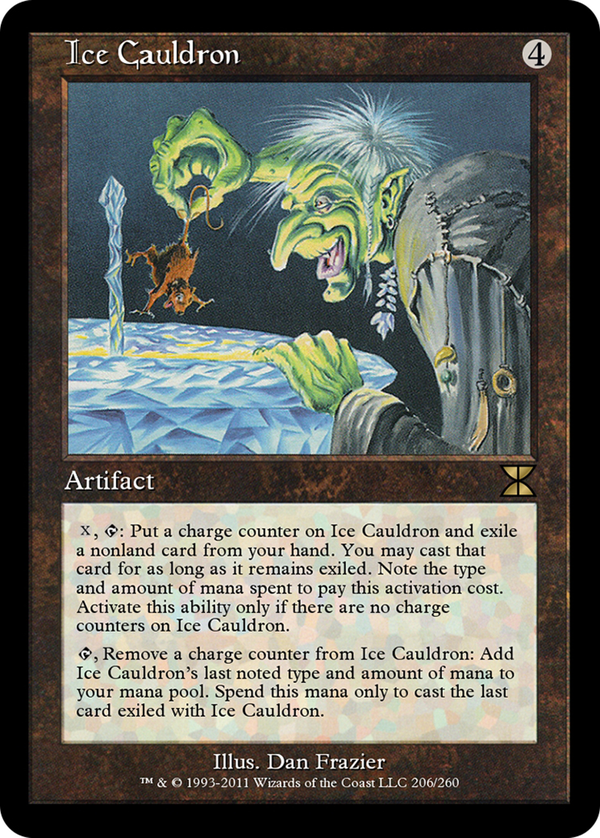
,  : You may exile a nonland card from your hand. You may cast that card for as long as it remains exiled. Put a charge counter on this artifact and note the type and amount of mana spent to pay this activation cost. Activate only if there are no charge counters on this artifact.
, Remove a charge counter from this artifact: Add this artifact's last noted type and amount of mana. Spend this mana only to cast the last card exiled with this artifact.
: You may exile a nonland card from your hand. You may cast that card for as long as it remains exiled. Put a charge counter on this artifact and note the type and amount of mana spent to pay this activation cost. Activate only if there are no charge counters on this artifact.
, Remove a charge counter from this artifact: Add this artifact's last noted type and amount of mana. Spend this mana only to cast the last card exiled with this artifact.