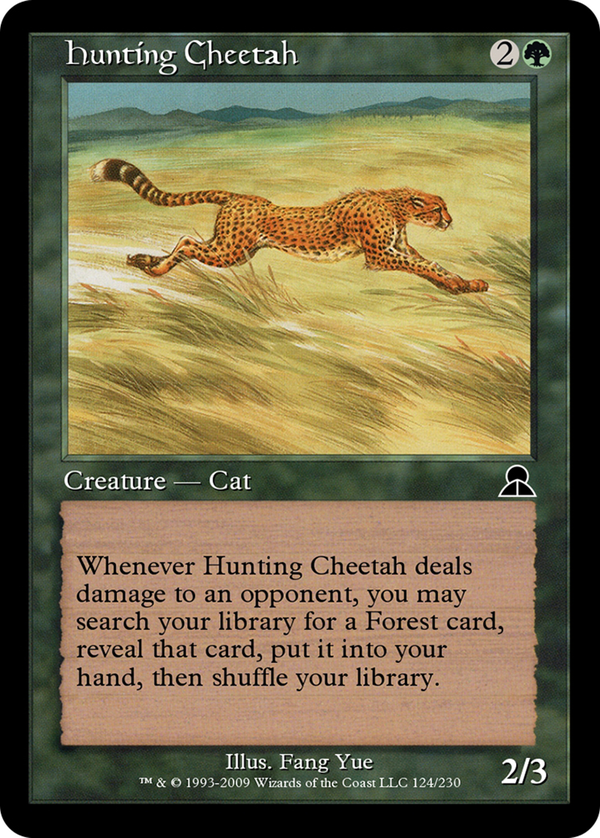
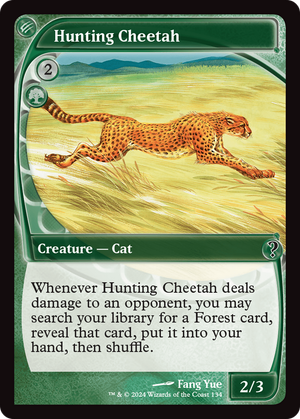
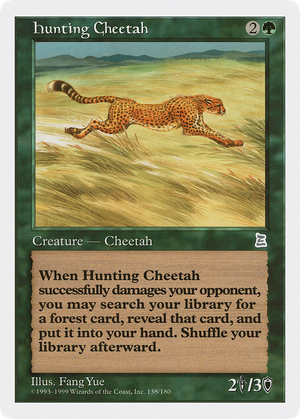
Hunting Cheetah


Green's early answer to the card-advantage problem was to make the reward conditional on something green does poorly: connecting in combat with a body that has no reach into the red zone. A 2/3 has to be pushed through or sneak past blockers to fire the trigger, and even then the payoff is a Forest card to hand, not a play that affects the board. That is the tell. The original ophidian-style designs paid a successful attack with a real card; here the draw is downgraded to a guaranteed-but-narrow land search, the era's compromise on letting green creatures generate advantage at all. The search is broader than it looks: it finds any card with the Forest subtype, which means dual lands and shocklands with green typing, not just basics, so a deck running Forest-typed nonbasics can tutor for fixing rather than vanilla mana. Even so, the effect smooths land drops and thins the library over a long game rather than ramping or refueling. It is value that compounds slowly and only when combat goes your way, which is exactly the shape of green's "creatures that draw cards" line before the color earned wider access to that effect. Read it as a snapshot of how cautiously that design space was rationed: a draw effect deemed too generous, swapped for a tutor whose ceiling is a land you might have drawn anyway.