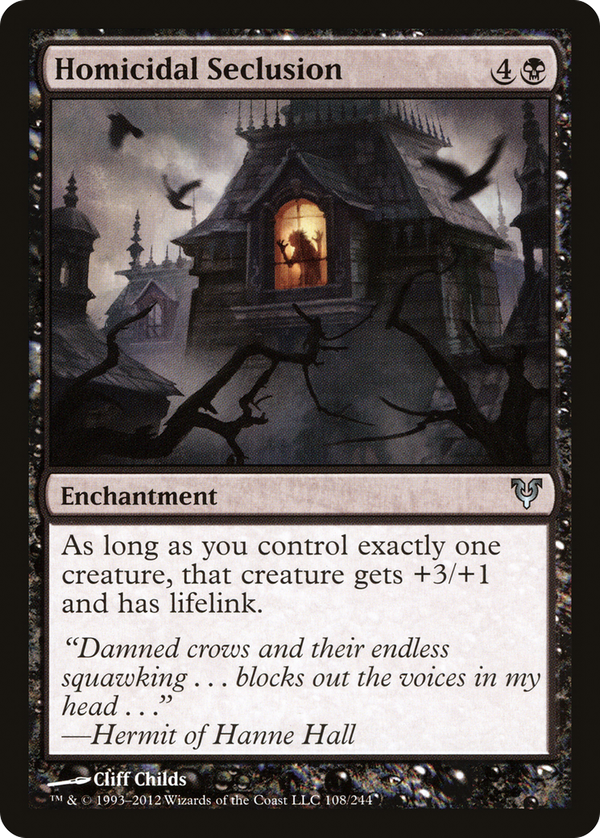
Homicidal Seclusion


The condition is a hard switch, not a sliding scale: the static bonus applies only while you control exactly one creature, so a second body shuts the buff off entirely, and an empty battlefield leaves the enchantment with nothing to act on. That all-or-nothing requirement puts the card at odds with nearly every other reason black wants creatures on the board, which is what makes it a puzzle rather than a payoff. The natural homes are strategies built around a single irreplaceable threat: a Voltron-style commander, a lone evasive beater, a deck that has already traded everything else away. There, the +3/+1 and lifelink turn one survivor into a clock that also stabilizes the race, and because the bonus lives on a global enchantment rather than on the creature, it survives the spot removal that would answer a creature granting the same buff. The same durable shell cuts both ways, though, since casting a second creature switches your own engine off; a topdecked blocker can sabotage you as much as the opponent. Few cards reward a board state that most decks spend the whole game trying to escape, the inverse of go-wide design, and that demand is what has kept it a curiosity rather than a staple. What sustains the interest is the friction between a generous stat-and-lifegain swing and the toll it exacts: an enchantment that asks you to keep your battlefield deliberately, uncomfortably empty.