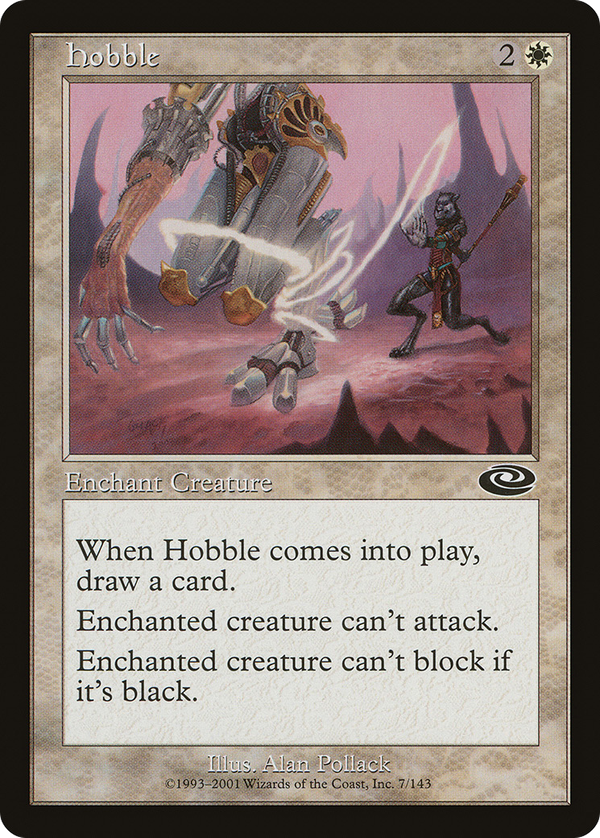
Hobble


Pacifism with a tuned dial and a refund. The base effect (an enchanted creature can't attack) is the cheap, durable answer white has always reached for instead of outright removal, but the second clause is where the design tips its hand: only black creatures lose the ability to block. That asymmetry is no accident. This sat in an era whose color tensions ran along the white-against-black axis, and the Aura reads as a piece built to punish that specific opponent. Against a black creature, it becomes a full lockdown, neither swinging nor holding the line; against any other color, the same Aura leaves a perfectly serviceable blocker on the table. The cantrip is the part that keeps a fixed answer honest against a moving target. Because the draw fires when the Aura resolves and enters the battlefield, you do not pay the usual penalty for guessing wrong on which creature to neutralize: you have already replaced the card before the game moves on. (The caveat is real: if the target is bounced or sacrificed in response to the Aura being cast, the spell never resolves, never enters, and the draw never happens, so the cantrip protects against later disruption, not against an instant-speed response to the cast itself.) It is a small lesson in how a narrow restraint earns its slot: the draw absorbs the cost of a misread, and the conditional block clause turns generic restraint into a pointed weapon when the matchup calls for it.