Hoarding Ogre


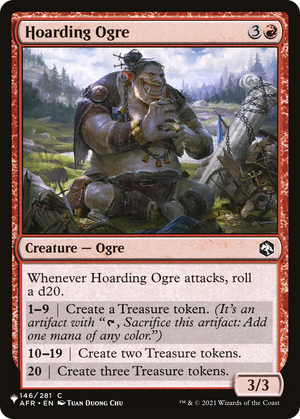
Combat becomes a small dice game: swing, roll a d20, collect Treasure on a distribution wide enough that even the worst face still pays a token. The low nine produce one, the ten-through-nineteen band hands you two, and a natural 20 dumps three onto the board from a single attack. Because the payout spans all twenty faces rather than resolving as a coin flip, two Treasures is the outcome you see most often, though the true average across the die lands at 1.6 per swing, a number worth keeping honest when you plan around the engine. That structure fires only on attack, so sending a 3/3 into an untapped board carries real risk, and the faucet depends on the Ogre surviving to keep swinging. That anchors the ramp to combat rather than to a one-time enters-the-battlefield payout, so tokens accumulate turn over turn instead of arriving all at once. And because each Treasure taps for any color, the reward escapes the red body entirely: every token is a sacrifice-ready ritual waiting for an artifact-matters or aristocrat shell to convert. The engine leans on the twenty-sided die that arrived with this era's dungeon-crawl designs, whose granularity lets one attack trigger spin a repeatable, color-flexible mana faucet out of a body that still holds ground on the turns it stays home.
Rules text
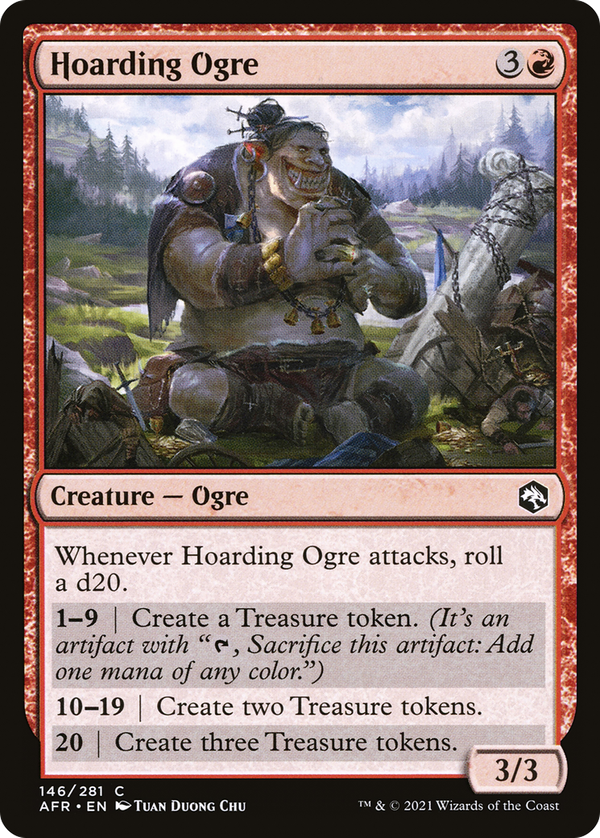
 , Sacrifice this token: Add one mana of any color.")
10—19 | Create two Treasure tokens.
20 | Create three Treasure tokens.
, Sacrifice this token: Add one mana of any color.")
10—19 | Create two Treasure tokens.
20 | Create three Treasure tokens.