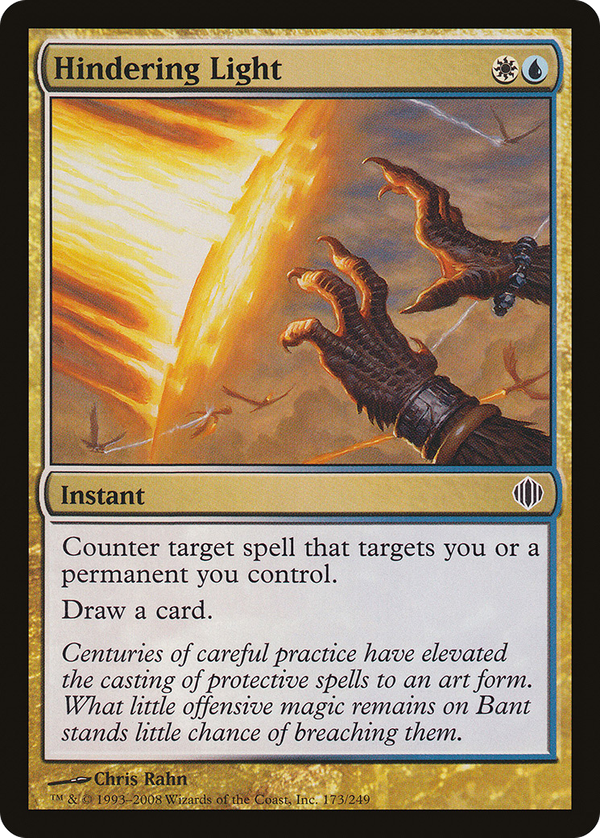
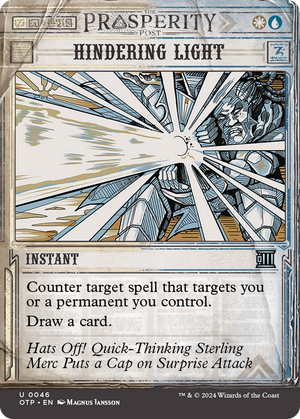
Hindering Light


The cantrip is the whole point. As a counterspell, this is deeply conditional: it answers only spells aimed at you or a permanent you currently control, which leaves it dead against board-development, ramp, and combo pieces that never target. The narrowness buys back the card. A typical two-mana hard counter trades one-for-one and breaks even on cards; this one resolves and replaces itself in the same breath, netting a card while it answers the threat. The design logic is to hand you a hard counter at no cost in card economy by walling off the situations where one would be too strong: it catches the things you most want stopped (targeted removal on your commander, a Doom Blade on your bomb, a burn spell pointed at your face) while refusing to behave like a generic Counterspell. The line of countermagic that bolts replacement value onto a hard counter runs a long way back; this entry sits at the affordable, low-stakes end of it, where the protection is genuine but the conditional is the price of admission. It rewards being held up rather than spent, because the payoff is reactive: keep two mana open, dare an opponent to point a spell your way, and convert their interaction into a denied resolution and a fresh card at once. Note the control clause, not ownership: a permanent you own but no longer control falls outside its reach.