Hickory Woodlot
The depletion lands were Mercadian Masques' answer to a question Magic kept asking in its early years: how do you make a cheap source of double mana without simply reprinting the moxen? The trade here is explicit and finite. Two depletion counters mean two activations, each producing a burst of green, after which the land sacrifices itself out of the game. It is a battery, not a permanent fixture; you are spending the land down to zero rather than tapping it forever. The entering-tapped clause closes the obvious loophole, denying you the mana on the turn it arrives and forcing the acceleration into a later turn where the tempo loss has been paid up front. What makes the depletion frame interesting as design is that it prices ramp by total output instead of by speed: the land can power out something explosive early, but it leaves you a land short two turns later, so the deck that wants it has to be built to spend the advantage before the floor falls away. That structural honesty, mana now in exchange for a hole in the manabase soon, is the discipline the whole cycle runs on, and it is why these lands read as commitments rather than free value.
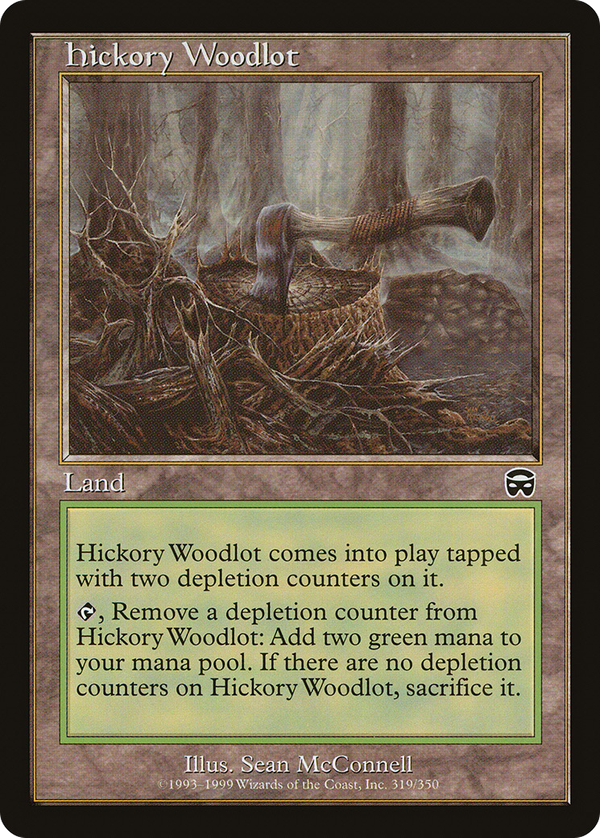
Rules text
 , Remove a depletion counter from this land: Add
  . If there are no depletion counters on this land, sacrifice it.