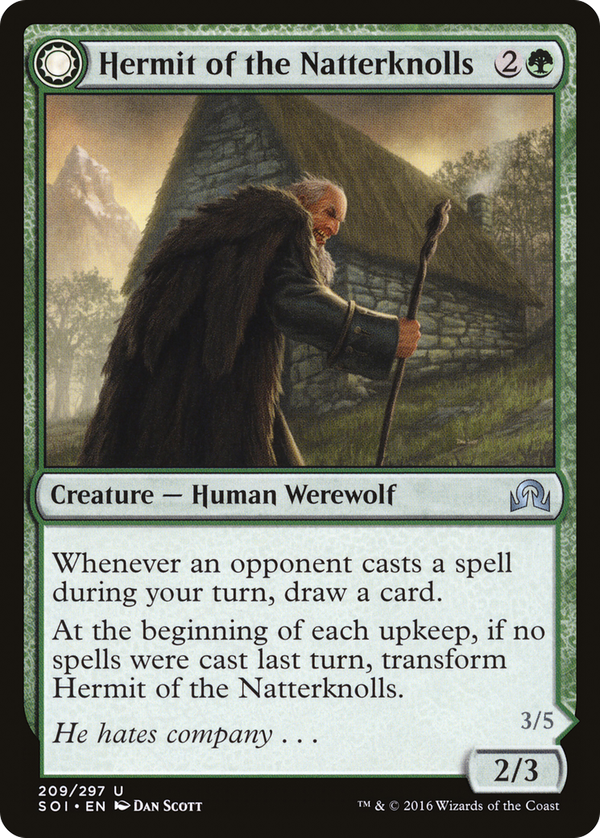
Hermit of the Natterknolls // Lone Wolf of the Natterknolls
Most werewolves flip on a passive timer: a quiet turn arrives, the wolf comes out, the board happens to satisfy the condition by accident of tempo. This one flips the accident into a plan by taxing interaction. The draw trigger fires only when an opponent casts a spell during your turn, which is the punishing half of a proactive game plan: you resolve a threat, they reach for a counterspell or a flash blocker, and you bill them a card (two on the wolf side) for the privilege of interacting on your clock. It rewards the tempo player who commits threats and dares the opponent to answer them, not the patient draw-go seat, whose spells land on the opponent's turn and never trip the trigger at all. The two halves reinforce that rhythm. The Hermit flips to the Lone Wolf when a turn passes with no spells cast, the lull that follows an opponent who has run out of answers; the wolf flips home only when a player casts two or more spells in a turn, the frantic doubling-up an opponent commits to when they are trying to claw back a board you already control. The 2/3 body is modest, but the conditional is sharper than the rate: it converts the opponent's own interaction into fuel, and grows meaner the longer they hold back. Among a tribe whose transform clause is usually an afterthought, this is the rare werewolf where the condition is the strategy.